
French cafés are not just a place, they’re a way of life in France. You can drink, eat, converse, read, watch the world go by, even make it your home away from home. For the price of a cup of coffee or glass of wine, your café table and the accompanying cultural panorama belong to you for as long as you like. What a way to “own” some French real estate!
But like so many aspects of French culture, it really helps to know some insider tips and info to enjoy your French café time to the fullest. Here are my top 10 recommendations for cracking the French café code. Read on, and make plans to head straight for a café next time you are in France.
1) Which café? Wherever you are in France—in a small country village or in bustling Paris—be sure to choose a café with the most French people (i.e. avoid anybody wearing fanny packs, cameras, and tennis shoes). You want to feel like you’re in France, not at a Starbucks back home.
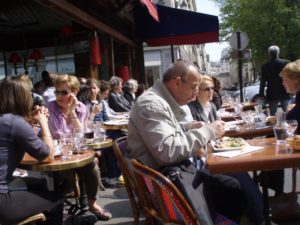
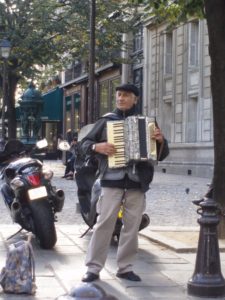
2) Where to sit? Hands down, if it’s a nice day, sit outside on the terrace. It’s great for people watching, and the weather in France is generally nice. There’s often some street entertainment going on such as the Paris accordionist below. These days, even in winter, café going can be a pleasure as many cafés have electric heaters overhead to keep things warm and toasty. If it’s a super hot day in summer, some cafés have water misters to try and cool things down. (Click here for a previous post on how to keep cool when it’s baking hot in Paris.) On the other hand, if you’re on a budget, sitting inside is always a good option since some menu items cost more on the terrace than inside the café. On that note, if you’re going in for a drink, standing at the bar costs less than sitting at a table. Ditto in Italy.
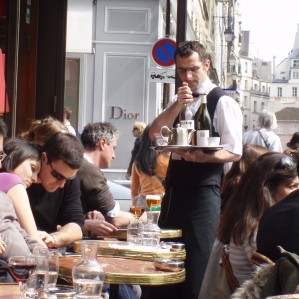
3) Engaging with the waitstaff: To ensure good relations with the French waitstaff, always greet your (usually male) waiter with a nice “Bonjour, Monsieur!” and attempt your best French accent. He’ll be more attentive to you if you try. And whatever you do, don’t call him over with a loud “Garçon!” It’s very 1950’s…and also rude.
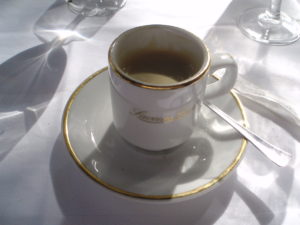
4) Ordering coffee: Coffee is a French café staple. You can order un express (an expresso), un crème (how the French order coffee with hot milk these days), un café américain (black coffee but not as strong as expresso—more like drip coffee) or perhaps un thé (tea). My morning beverage in France is un grand crème, or an extra large coffee with hot milk. Note that the French do not typically take milk in their coffee later in the day or at night—it’s strictly expresso for them following lunch or dinner.
5) What about other drinks? There are a variety of beverages on offer at French cafés besides le café (coffee). Of the non-alcoholic variety, you can order un citron pressé (fresh-squeezed lemonade where you add sugar and water to taste), les jus de fruits (fruit juices), un Orangina (sparkling orange soda made in France), un coca / coca light (Coke and Diet Coke) and les eaux minérales such as Vittel or Evian (flat mineral waters) and Badoit or San Pellegrino (sparkling mineral waters). It is helpful to remember that Coke can cost more than the house wine in France. Also, hip French people these days forego all the wonderful French mineral waters in favor of San Pellegrino. Go figure?!
If it’s apéritif time – a ritual in France – you can opt for one of the many interesting libations on offer. Draft bière (beer) is available as une pression or un demi (half pint). And then of course, there’s wine—un vin rouge, un vin blanc (a glass of red or white wine) or un rosé (glass of rosé wine). In summer in France, I often drink chilled rosé from Provence as it is the perfect warm weather drink. If you are celebrating something, or even if you’re not, a nice coupe de champagne (glass of champagne) is always a great beverage option in France. Then too, there are some good special wine-based possibilities such as Lillet or Pineau de Charentes. Finally, you can order hard liquor, brandy (France has amazing ones, bien sûr), or something like pastis, the licorice flavored liqueur typical of southern France.
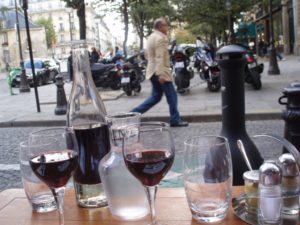
6) What about café food? Food is almost always good in France, even in low-key cafés. The menu du jour (day’s set menu) allows you to have a nice meal—often a starter, main dish and dessert—for a reasonable price. Another option is to ask the waiter what he prefers on la carte (the paper menu). He’ll be flattered you asked his advice, and often times will go above and beyond to make sure the plate he brings to the table is well prepared.
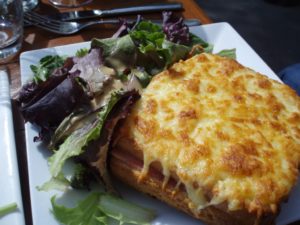
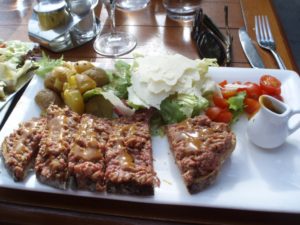
Or you can order quintessential French dishes such as quiche lorraine, un croque monsieur (open faced hot ham and cheese sandwich) or steak tartare served with a green salad. While most cafés won’t win gourmet food awards, you’ll get a good, honest meal and experience a slice of French daily life at the same time.
7) How to get the check? In French cafés and restaurants, you must always ask for your check, or l’addition. Make eye contact with your waiter and call him over with “Monsieur.” Then you can say, “L’addition, s’il vous plaît.”
8) What about tipping? Tipping in France is often confusing for Americans. French tipping is included in the price of food and drink; menus will say service compris somewhereto indicate this. So leaving another 15 to 20% can come off as an insult—the waiter might think you see him as a charity case. However, I have seen waitstaff in Europe who take advantage of the fact that foreigners are not aware tips are already included and relish or even encourage the additional tip windfall. In French cafés, the right protocol is to pay your check with cash or a credit card and then leave a bit extra in cash–typically 5% or less–as a gesture of good will.
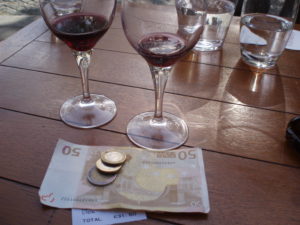
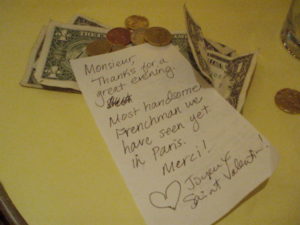
You can also leave a cute note for your waiter. I once took some college girls on a February trip to Paris, and they thought our young waiter at Les Deux Magots was handsome enough to merit a quick thank-you note in English with a nice “Happy Valentine’s Day” in French. We left the café before he came back by our table—I wished I could have seen the look on his face when he read it!
9) Toilettes: You can use the facilities in a café if you are a paying customer. Note that café restrooms are often in the cellar or basement so look for a small stairway going downstairs. If it’s not obvious, you can ask one of the staff in polite French, “Monsieur, s’il vous plaît – où sont les toilettes?”
10) Good Paris cafés: Next time you are in Paris, drop by the Left Bank café icons Les Deux Magots and the Café de Flore. They’re pricier than some but the people-watching is divine. While there will be tourists, enough French people fill the tables to make these cafés endlessly interesting. A little more off the Left Bank beaten path and one of my favorite cafés in Paris is La Palette on the Rue de Seine. It’s very French and what most cafés used to feel like.
If you have a great café anecdote to share, let other French Affaires readers in on your experience by posting it here. We love to hear about any and all French cultural adventures!
NB: A version of this article was previously published on the French Affaires website in July, 2011.
French Take-Out™ ~ La France à emporter
For a great French apéritif experience in the U.S., think about joining us for the special French Cuisine & Culture workshop this weekend. From 3:30 to 5:30pm on Saturday in Dallas, we’re hosting “French Happy Hour: The Art of the Apéritif in France.”
In this unique offering, we’ll explore the cultural aspects of ‘happy hour’ in France, how the French use the apéritif moment to encourage the appetite, which types of apéritif drinks are often served, how to order apéritifs and which types of appetizers complement the apéritifs. Our class also includes a tasting of several French apéritif beverages and the hands-on French appetizer making class. Following our cultural lessons, tastings and appetizer-making class, we’ll sit down and enjoy our French appetizers with apéritifs and talk about great apéritif venues in Paris!

The cost is $75 per person and includes the hands-on French appetizer making class, wine & liqueur tastings, cultural lessons, an array of French appetizers with apéritifs, recipes and a guide to great apéritif venues in Paris. Advance registration is required. Class size is limited. Please click here for more information and to register. Or email us at info.french@frenchaffaires.com.