
What would Paris be without the Seine? The picturesque waterway has been a great geographic, economic, social and artistic force since the city’s earliest days, long before the Bateaux mouches and Paris Plages showed up. Its peaceful waters reflect some of the most prestigious architecture in Paris, including the Louvre, Musée d’Orsay, Institut de France, Grand Palais, Petit Palais and Notre Dame cathedral.
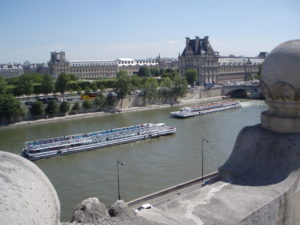
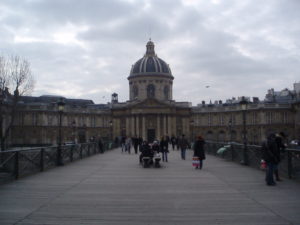
Paris has 37 bridges that cross la Seine (pronounced “la sehn”), three of which are pedestrian only and two are rail bridges. The oldest bridge is the Pont Neuf which translates ironically as the “New Bridge.” My favorite pont for years has been the pedestrian Pont des Arts. It links the gorgeous Institut de France on the Left Bank with the impressive Palais du Louvre on the Right Bank.
Speaking of banks, I often get the question about how the Paris banks became designated the ‘Right’ and the ‘Left.’ The answer takes us to the origins of the Seine. The 777 kilometer river extends from the Plateau de Langres in Burgundy all the way to la Manche (the English Channel), passing through Paris and Rouen in Normandy along the way. As the Seine traverses Paris flowing west, you will find the Rive gauche (Left Bank) on the south/left side when you face downstream and the Rive droite (Right Bank) on the north side, i.e. on your right. The late fashion designer Yves Saint Laurent immortalized the expression Rive gauche with his brand and fragrances of the same name.
Another Seine designation worth mentioning also involves the river’s banks. The two sides of the Seine have been named a UNESCO World Heritage Site in honor of the spectacular urban evolution visible there. According to UNESCO, the Paris setting of the Seine “constitutes a remarkable example of urban riverside architecture, where the strata of history are harmoniously superposed.”
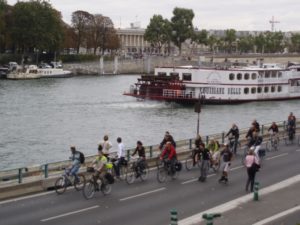
Today, the Seine’s entertainment factor in Paris is completely assured. You can take your pick from a myriad of activities: browsing the bookstalls of les bouquinistes, taking a boat ride on the Bateaux Mouches, enjoying the sun and sand of the Paris Plages (Paris beaches) in summer, walking with your sweetheart along the water day or night, and biking and rollerblading on the weekends. In fact, the city of Paris has gotten so serious about riverside fun that it regularly closes off some of the roads along the water to cars on Saturdays and Sundays. Check out this cycling group taking advantage of the car-free thoroughfares.
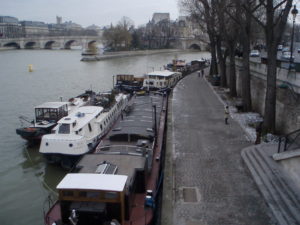
And for those desiring a floating domicile in the City of Light, a French houseboat or péniche is the way to go. Did you realize there is a whole community of people living on the water in Paris?
But if we think the Seine is entertainment central now, just wait until the new urban project Les Berges de Seine is finished this year. Efforts have been afoot by the City of Paris to transform the quays and riverside roads into floating gardens, promenades, cultural centers, and leisure spaces. There are creative ideas for art exhibitions on floating péniches and lunchtime activities on Wednesdays and Sundays for young and old alike. A quai-side restaurant is even part of the plan. So the next time you are in Paris, be sure to put exploring the Seine’s new look on your to-do list. It will be a Paris ‘Seine-sation’ beyond your wildest dreams!
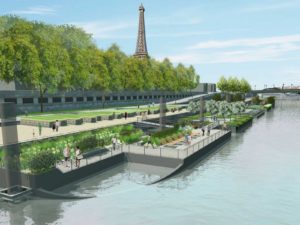
Illustration courtesy of the Mairie de Paris
French Take-Out ~ La France à emporter
For a preview of the new berges de Paris, you can take a tour courtesy of the City of Paris. Click here for illustrations of the various facets of the project.
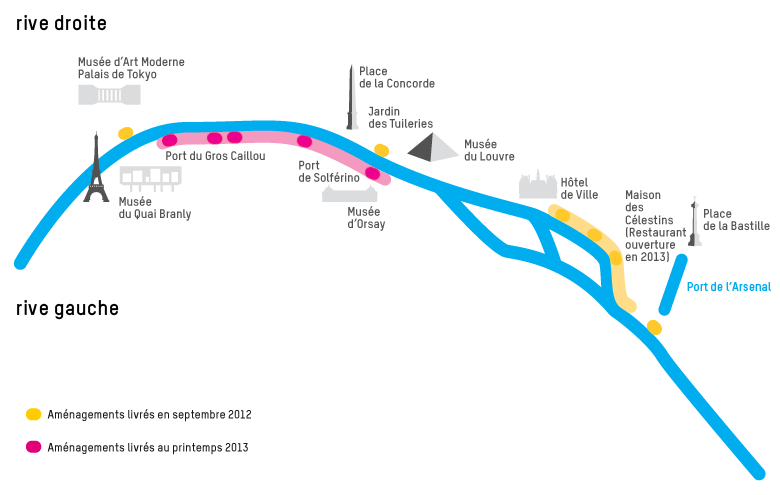
Of course as is usually the case in France, the riverfront extravaganza has not been without controversy. Several urban groups opposed the plan since it reduces car access on central Paris roads. And the 40 million euro price tag surely made others pause in these days of cost-cutting and austerity in Europe. Still, beauty often trumps all in France – that’s why many of us like it, after all! – and the project will be completed within the next few months. I can’t wait to enjoy this new ‘park’ in the heart of Paris – and see how it folds in to the interesting daily life of the city.