
Have you ever wanted French cuisine to be, well, a little more piquant (peppy)? Occasionally, I have. Don’t get me wrong, I love all aspects of French cuisine, especially those subtle tastes and flavors that the French do so well. But every so often, you need a meal with some spice. And when you do, just head down to the Basque country.
For about four centuries now, Basque cooks have been using their special spice factor—the piment d’Espelette—to flavor their cuisine.
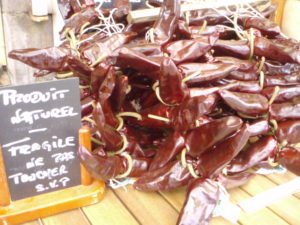
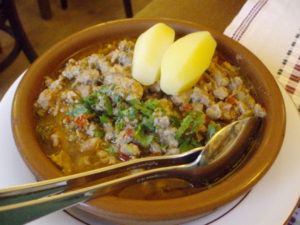
Introduced into the region around the village of Espelette from South America in the seventeenth century, this special chili pepper has added a smoky, fragrant and slightly hot taste to all types of Basque dishes including poulet basque (Basque chicken), jambon (ham), pâtés, piperade (slow cooked tomatoes, red and green peppers , and spices) and axoa (a ragout of veal that is to die for!). In fact, axoa is my favorite Basque dish.
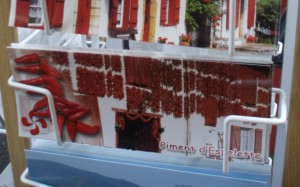
As the peppers grow in Espelette and the villages nearby, they are green on the vine. Then the peppers are picked in the fall and hung to dry on balconies and buildings turning a deep red hue to form guirlandes de piments rouges (garlands of red peppers). Once dry, the peppers are often ground into a powder which you can buy in a small pot (jar) for about 6 euros.
To figure out just how hot this chili pepper is, I consulted the Scoville scale. Developed in 1912 by the chemist Wilbur Scoville, the scale measures the spicy heat, or piquance, of chili peppers. The piment d’Espelette rates level 4 on the scale, slightly spicier than the ancho chili pepper but definitely less hot than the jalapeno. (I love the French terms on the scale below–cayenne ranks as ‘torrid’ and tabasco as ‘volcanic’ in spiciness!)
|
Table simplifiée de Scoville |
|||
|
Degré |
Appréciation |
Unités Scoville |
Exemple |
| 0 | neutre | 0 – 100 | Poivron |
| 1 | doux | 100 – 500 | Paprika doux |
| 2 | chaleureux | 500 – 1 000 | Piment d’Anaheim |
| 3 | relevé | 1 000 – 1 500 | Piment Ancho |
| 4 | chaud | 1 500 – 2 500 | Piment d’Espelette |
| 5 | fort | 2 500 – 5 000 | Piment Chimayo |
| 6 | ardent | 5 000 – 15 000 | Paprika fort |
| 7 | brûlant | 15 000 – 30 000 | Piment Cascabel |
| 8 | torride | 30 000 – 50 000 | Piment de Cayenne |
| 9 | volcanique | 50 000 – 100 000 | Piment tabasco |
| 10 | explosif | 100 000 et plus | Piment habanero |
So you can use piment liberally without putting your mouth on fire. In fact, the Espelettards (people from Espelette), have the following motto: A consommer sans modération ! (Consume without moderation—a play on the phrase ‘A consommer avec modération’, consume in moderation , as required for alcoholic beverages in France.)
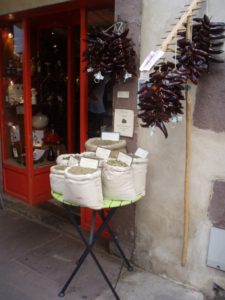
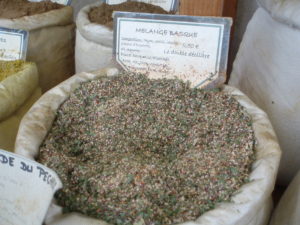
In practically any gourmet boutique in the Basque country, you can find the piment d’Espelette in a variety of forms-–the regular powder, jelly, jam, spicy oil for grilling, flavored salt, and even chocolats au piment d’Espelette. I found a wonderful jar of garlic cloves marinated in olive oil flavored with piment d’Espelette. And this vendor had a tempting array of dried spices that included mélange basque—basically a herbes de Provence mixture to which piment d’Espelette had been added.

This weekend, you can find all these products and more at the Fête du piment d’Espelette. The festival is held every year the last weekend of October in the town of Espelette itself. In addition to the food fair with piments and regional products for sale, there are parades, concerts, pelota games and a competition for the best chili pepper of 2010. On Sunday, everyone sits down to a piment-inspired lunch at one o’clock following the Sunday mass and bénédiction du piments (blessing of the peppers). This year’s festival also marks the tenth anniversary of the piment’s AOC status, an official recognition of this regional product’s uniqueness.
Check out the piment d’Espelette website for more details on the festival and on the French chili pepper: http://www.pimentdespelette.com/. I particularly liked the “Recette du mois” (recipe of the month) section—this month’s winner created a “Piperade façon tarte tatin et sa glace au piment d’Espelette” (a savory version of the dessert tarte tatin). You can click here to see her recipe.
If you are inspired to cook with the piment d’Espelette in the U.S., you can find it at a variety of stores online. When in France, you can of course buy some in any Basque town or in Paris at La Grande Epicerie on the Left Bank. Happy, hot French cooking!
French Take-Out™ ~ La France à emporter
French Affaires readers in Dallas can enjoy a piment d’Espelette festival of sorts next week at Cadot restaurant. French chef Jean-Marie Cadot is offering an Espelette chili dinner from October 25 to 29 which features five courses for $39.95. The Basque chili menu includes:
Tomato & Red Bell Pepper Garnished with Espelette Crème & Popcorn
Crêpes with Shrimp, Onions, Espelette & Hatch Chilies, & Scrambled Eggs with a Mixed Green Salad
Blackened Ahi Tuna with Hatch Chilies, Prosciutto, & Chichoré Lettuce
Cornish Hen with Lemon Preserves, Espelette & Hatch Pipperade, & Roasted Fingerling Potatoes
Crème Catalane (Crème Brûlée)
Cadot restaurant’s chef Jean-Marie is a native of Paris and grew up in a family that’s been in the restaurant, hotel and bakery business since the 1700’s.
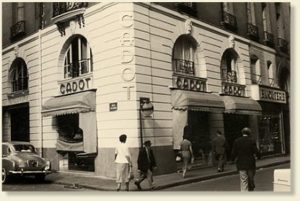
He trained in France before continuing his culinary career in New York City and Dallas. He opened his Dallas restaurant Cadot in 2009 bringing wonderful traditional and new French flavors to the Dallas dining scene. Reservations are recommended for this special Basque chili dinner. For more information and to reserve, please click here.