
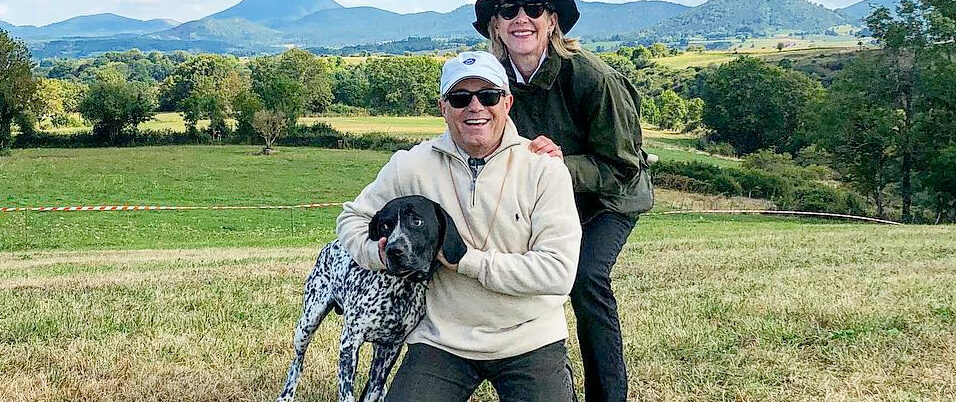
24. Les Buveurs d’Air
In the second field trial, I asked that Marcel go last. I was still a bit gun-shy after being first in the field at the Berry event. People wanted him to show his best stuff, as I mentioned, and so were happy to comply. We got to watch all the other dogs and their owners before it was our turn. I could also observe the folks in charge of putting out the birds, and how they went about their placement. A field trial isn’t about hiding a bird from the owner in the field. He isn’t hunting. The dog is.
Marcel did brilliantly and passed with high honors. One thing, however, I took note of. Going last meant that there was a lot of bird scent in the field and stray feathers. For Marcel, it was a field full of quail emanation. On occasion, he’d stop and point hard where there was no bird, but just a feather. The judge took full account of this. As did the others. This wasn’t the first field trial where that was a challenge. What it did show was that Marcel had a hyper-scent. His flaire in French parlance.
The drive down to Cognac for the “best under three’s” event takes you past Orleans, Tours and Poitiers. By air, we are not too far from Soulac-sur-Mer and the northern tip of the Medoc. This is the Charante region. I pass the big Hennessey buildings coming into town. Cognac is the home of cognac. I have booked a hotel on the outskirts of town which allows dogs.
I have made good time and have the rest of the afternoon free. I didn’t want to feel pressured. Elizabeth is doing a French Affaires trip and I’m on my own with Marcel. We find some paths along the Charante river, and I give him some exercise. I have the map and directions for the event, and I want to know the distance and the route so I can relax in the morning. I let Marcel run around in the field where tomorrow the competition will be set up. It is the Fall now.
Back in town I find a nice brasserie for dinner, Marcel at my feet. This is one of the nicest features of France. The way they make room for pets. Marcel knows the routine and cozies up next to my feet. I think of the café in Fontainebleau where Elizabeth and I said hello to our first Braque d’Auvergne. The roads and adventures Marcel has taken us down, and that he will share with us in the coming years.
The event the following day goes well. Marcel is the runner-up “best under three’s.” He gets a nice trophy and a medal with tricolor ribbon to hang around his neck. The competitors are all contented with the results and I am pleased. I’ve gone from rags-to-riches. I get on the road after the usual festivities anxious to be back at le Presbytère before too late. I haul his crate into the courtyard of our snug home. Marcel heads up to his bed. Il a gagné le trophée. I put it on the mantle so Elizabeth can see it upon return, remove Marcel’s medal, and head into my own bed for a good long sleep.
Well done, mon chien. Je suis fiers de toi. I’m proud of you.
Up the next morning, we do our usual romp in the chateau grounds. Back for coffee and a trip to the boulangerie.
At the event in Cognac I realized it was time to move from field events to the field itself. Clearly Marcel had flair and flaire both. In our commune, the hunters were already assembling on weekend mornings, working the fields around our village and beyond.
I would put myself among those not native French who are surprised to learn how keen they are on guns and hunting. One local offered that before the Revolution, the only people generally allowed to have guns were royalty (think the owners of the chateau where we lived) and soldiers. All that changed in 1789. Farmers who might well have owned guns in the south of France were now joined by the wider citizenry anxious to be able to have firearms for self-protection and the clearing of pesky birds attacking their fields, hogs and roe deer.
From the hunting on horseback done by upper classes, or the driven hog and deer clearing organized for them, or the shooting of imported pheasants, now we have seasonal hunting by the citizenry of the communes. You know it is underway as signs are posted on Montgomery’s forest road linking Fontainebleau (and the Anglican chapel there) with our home twenty minutes away in Courances. Chasse en cours they read, with a big hog-snouted face if your French isn’t too good. Hunt in progress. You see these same signs all over France in the Fall and through the Winter months.
I will learn that the procedure is to gather on Saturday (and Sunday, but not for me) mornings, at a location posted at the Marie. There is a farm outside of our village as you climb the hill, and I know the road and place well. It is on my afternoon bike route. In fact, it is an assembly of barns and hangars for farm equipment and tractors, with a big area where you can park. Our commune group consists of about eight, with their various dogs.
The mayor of our town is a good-natured Portuguese woman whose brother-in-law is the enthusiastic organizer of the hunts. (There was a big influx of Portuguese into France during the Salazar dictatorship in the earlier twentieth century). Famous as stone masons (among other things) they were in much demand at places like the Chateau of Courances. Our housekeeper Maria and her husband Adelino were proud portugais. He is in charge of our property outdoors, and Elizabeth’s transformation of the garden.
I was always struck at the Fête Nationale ceremony or kindred public events in front of the Marie, how many Portuguese would be present. They were extremely proud French citizens, the country to which they had fled for refuge, that had welcomed them and taken them in. Also at our catholic church, their favorite saint’s days were celebrated with gusto. Street processions with statues of the Virgin, singing, big family gatherings, colorful outfits.
The hunts would consist of birds in the fields in the morning, and hogs and roe deer in the forests in the afternoon, our Portuguese leader explained. He explained the deroulement, though it was pretty straightforward. When the time would come, I would just hunt in the mornings. Marcel is too powerful to control if he starts coursing hogs, and it would be dangerous in my view. Elizabeth forbad it, and that settled that.
I would need to get Marcel a bit more training, I felt. Friends in Cognac recommended the trainer numero uno in France, if not in continental Europe. As Filson outfitters say, “might as well have the best.” His name was Immanuel Bourgeois. His operation was in Lower Normandy, a hilly and woody section known as Le Perche, presently favored by Parisians because easy to get to for weekends in the country.
His business was known as Les Buveurs d’Air. Air-drinkers, literally. Marcel had proven he was a very good buveur d’air at the championship in Cognac. Now I needed to be able to control him in the field, and around other dogs, off lead.
Off he would go for two weeks in November. Meanwhile, I had my own training to do if I was to get the required permis de chasse, the hunting license necessary to hunt and also to buy a gun in France.