
12. Soulac Dimanche
Along with the occasional hogs, we were struck by the many surprises this region of France presents. Our assistant at the church in Soulac was a well-known personality in the Medoc, earning her the sobriquet “La Reine du Medoc.” A single woman in her early seventies, effervescent, an infectious smile, she had worked for the Rothschild family in their international wine trade affairs. She lived in Pauillac on the Gironde, and her office had been at Chateau Margaux. She gave us a private tour. I learned that the premier cru often tasted better than the grand cru. The latter was for investors who let it age and gain in value, and only then open it.
She also lived, as it happened, on the Tour de France route that particular summer. She invited her local friends and people from the congregation in Bordeaux where she worshipped, for a celebration of the famous event. I will never forget Elizabeth and I on her balcony, watching the thunderous banging of the side rails below as the cyclists zoomed by. This would be the final “time trial” event before they whisked off to Paris for the finale.
And the Atlantic beaches. Anyone who has been to the more famous Riviera coast knows it is like a sardine tin, your beach blanket like a postage stamp in a booklet of stamps. If you can find one, or a parking spot not 2 miles away for that matter. I recall us going to (what we thought would be) a quiet beach spot west of Toulon, in August. Saint-Cyr-sur-Mer. About 200 meters from the town center, it was clear this was a doomed mission. Traffic stalled, no parking places, people pulling their vehicles into improbably tiny slots not meant for parking. We just turned around and went home. The sandy beach and blue water beckoned, but we saw only masses of flesh, like the puppy pile at the breeding kennel.
If you want wide beaches, ample parking, great surf (if a bit rough; this is a surfer destination), great beach walking, long empty stretches, you have come to the right place. You typically park high above the sea below, scamper down nice trails, lugging your beach necessities, come to the bottom and survey a grand choice to call your own for the day. You may also choose between full nudity, if so inclined, or topless, keep your maillot de bain on, or some mixture of the last two.
Elizabeth and I were staying in Carcans, and so the closest beach was Carcans Plage. The area is not crowded, so we tried several spots, Lacanau, Hortin, Pin Sec, and others. Our favorite was Pin Sec. High above the beaches, you parked. There is a super sea food restaurant there, more like a stand, but with places to sit under beach umbrellas. Population, 50 beach goers, ample parking, take that Saint-Cyr-sur-Mer.
At this special spot, down on the beach, one sees unusual concrete installations. Like the huge top of mushrooms, emerging from the sand, a hundred feet across. Now splotched with bright, happy, summer colors. Surf boards stacked alongside. Children playing inside their little cockpits. Dads throwing frisbees. Surf breaking. What a bucolic scene.
Since the allied invasions are associated with Normandy, one forgets that the Germans (who had commandeered the French population to build submarines in La Rochelle not far north, above the Medoc) thought the enemy would land here. The Atlantic Wall. We were looking at bunkers. Their resemblance to those at Pointe du Hoc now coming into frame. Not high on a cliff, however, but along the sea.
German bunkers become the playground for little French children only fifty-years on. The joy of beach-going replacing the fear of Nazi occupation, in the same lifetime of older citizens living in the area.
On Sundays, Elizabeth and I would drive north to Soulac-sur-Mer where I would offer church services in English. The whole area attracts campers and campgrounds are prevalent as you move north toward Soulac. The idea was to attract holidaymakers wanting to have Sunday church. Germans, Scandinavians, the Dutch, and the British. English is of course now the common language, replacing French in that role two hundred years ago.
The Queen of the Medoc would help set things up. We had light attendance the first Sunday. Undaunted, she put signs on her little Peugeot and would drive around the camping grounds with a bull horn. “Come to church in Soulac-sur-Mer. 11.30am. At the Temple.”
By “temple” is meant the protestant place of worship, in this case, l’église reformée. Soulac is also home to a grand Basilica, Notre Dame au fin des Terres. The little church where we gathered could hold about 100, tops. We had about 40 the first Sunday. The regular French Protestant congregation met at 10.00. They had graciously allowed us to use their parish for our six-week long mission.
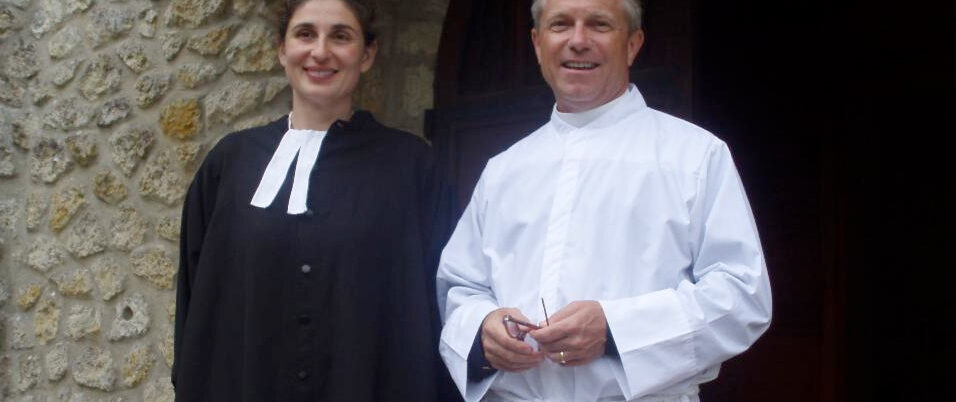
The pastor was an attractive, intelligent looking woman in her thirties. Basque. Jet black hair, setting off her starched white preaching-tabs overlaying her black cassock. The vesture of the l’église reformée. Her congregation was itself not sizeable. And decidedly older. Elizabeth and I went to church with them before our service to meet her and get a sense of the setting.
She spoke a bit of English, matching my bit of French at the time. Elizabeth was our go-between. We enjoyed each other’s company, she obviously intrigued to have this American and his French-speaking wife land on her doorstep in a remote corner of the Medoc. It was proposed that, alongside our intended arrangement, we would do an ecumenical service. Her usual congregation, together with our fledgling English-speaking-holiday-maker worshippers. We would split the difference and meet at 10.30. Flyers went out. The Queen of Medoc altered her bull-horn announcement accordingly.
When the Sunday arrived, there was a pleasant buzz in the air. People milling around prior to the service time. Strangers meeting. Smiles and awkward efforts to communicate. The French congregation was putting in an effort. They were proud and excited to have us descend on them.
A temple does not typically have a sanctuary as we may envision that. That is, a raised-up area at the front of the church, with an altar and lectern, where the clergy leadership conduct the service. A bit “set off” in some architecturally designated way. The congregational seating, rather, extends right up to the front of the church. The reading/preaching lectern and sacred table are in close proximity to the front row of seating.
When the congregation is filling up a third of the space, the effect is different than when the church is full, as it was, happily, on this occasion. The ten of so front row seats were grabbed by the first proud French worshippers. They had hustled up for a front-row view. This is our church! Their pastor is to host an American who has come to Soulac and has brought fresh faces to worship with them. The church was full. French, Dutch, Scandinavian, British, and German. Perhaps others as well.
Mme Pasteur and I had discussed the format. The service would be in French. I was to preach and she to lead the worship as her people were accustomed to. Others would follow as able. I can recall being seated beside her, curious faces looking at me from about five feet away. I would preach in English, so everyone could be a tad equally discomfited.
I asked my wife if she would offer a translation in French. She looked at me as if I were asking her to detail the car or do the taxes. Come on, girl, they will love it. Reluctantly – you owe me one – she agreed. I gave her my text before the day so she could familiarize herself with her role as traductrice. I still owed her one.
Mme Pasteur showed me the feuille or one-page printed service sheet. This was not a high budget operation. They also had hymn books in the thirty or so now full rows of seats. The sign board up front indicated the hymn numbers. I do this sort of thing regularly enough I thought to take a look at what she had chosen. How charming. The final hymn would be one that had verses in different languages. How ecumenical. Great idea.
10.30 came, a simple bell was rung, and off we went. I judged the morning as going very well. It came time for my address. I could tell from the faces staring up at me that some were listening clearly and others hadn’t a clue. The French congregation was predominantly older, and resolutely middle or working class. They didn’t have CNN on their TV sets. English is not spoken. I had figured as much so wrapped things up with a flourish of some kind when the short homily ended.
Now it was Elizabeth’s turn. Being now myself a spectator, I could see the before and after shot. Every French head was turned to her and listening to every word. Nodding, smiling, oh, yes, of course. Well done. Thank you. Their faces glowed with pride. Our language, thank you very much. You are so very welcome here. Bienvenue, tout le monde!
I wanted to elbow her and say, now you owe me one. But she took her seat in the front row with the others. Soon the service would draw to a close. I was very pleased. Mme Pasteur was very pleased. The congregation was very pleased. The holidaymakers very pleased.
She rose and called out the final hymn. All stood and we started in.
First verse was in French. The lovely language echoed to the walls and ceiling above. Next, English. They tried and we did our proud and strong singing. Next Dutch. The Nederlandais were thrilled to be given a chance, and we faked it.
I am a fluent German speaker and so was glad to show off for the fourth and final verse. I started in with gusto. You could have heard a pin drop. The French people in row # 1 folded their arms across their chests. I modulated my tone and then joined the silence.
The bunkers on the beach had not fled from their consciousness. The days of occupation recalled. We were in church, a place of forgiveness and new life. Silence always precedes that, when there has been a severe wounding. Something felt right about the way the silence descended. A tribute to lost friends and family.
Generations come and generations go. Playing on the beach alongside those dreadful installations has its proper place now. God holds the times in his hand. Silence at the temple in Soulac sur Mer as well as children playing loudly on the beach.
When the service was over, I must add, what a grand celebration followed. What a rousing success our little ecumenical experiment. There were drinks and snacks, and new friends made. Elizabeth was thronged by the locals. Mme Pasteur and I had a hug.
God was on site that special day.