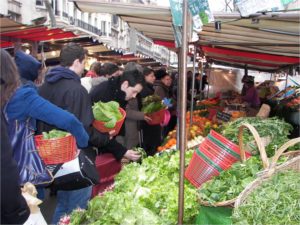
If you’re like me, spending time in France’s open-air markets is an endless pleasure. The sights, the sounds, the colors, the smells, and the people all come together to create a festive and unique experience for French and non-French alike. Markets in France are a culinary experience as well as a social one–people from all classes and walks of life rub elbows in the common pursuit of good cooking and good meals.
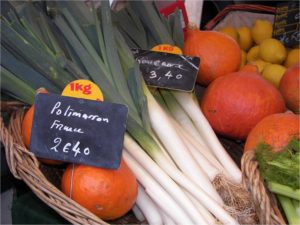
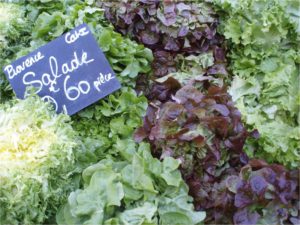
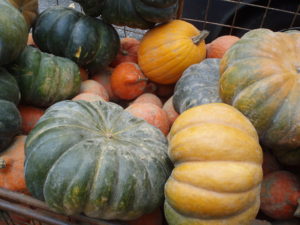
I often get asked about how to get the most out of various aspects French life, in particular the open-air markets. So today’s posting is a quick primer on the spoken and unspoken rules for participating in French market life.
1) When: Markets operate roughly from 8am to 1pm. Get up and go early for the top offerings. Depending on the town or city, markets run once or two to three times per week all year long. For example, the Boulevard Raspail market on Paris’s Left Bank happens every Tuesday, Friday and Sunday, with Sunday featuring the completely organic, or biologique, market.
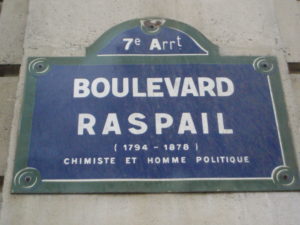
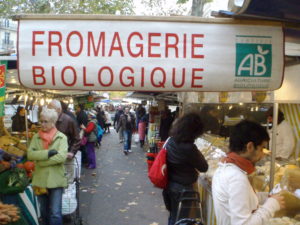
2) Seasons: Take advantage of the intensely seasonal offerings in France. Buy strawberries and melons in summer, figs in late summer and early fall, apples and mushrooms in the fall and winter, lettuces in late winter and spring, you get the idea. And be sure to buy local so that the food products are super fresh. French vendors are great about noting where their food is from.
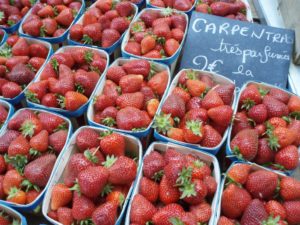
“Very flavorful” strawberries from Carpentras in southern France

3a) Choosing your food: Most vendors will choose food items and bag them for you. Always assume that this is the case and you won’t have any problems when shopping in French markets.
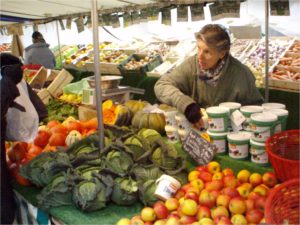
Note that vendors have spent a considerable amount of time on their beautiful displays so you don’t want to make a lovely mountain of artichokes come tumbling down…
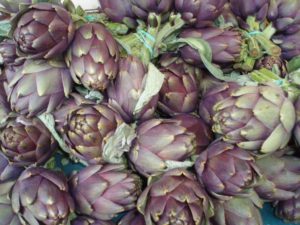
3b) Part 2 of why vendors consider it their job to choose your food items: After all, this is their métier (career) and they have the expertise to pick perfect peaches or a camembert that will be ready for your lunch tomorrow, if that is what you want. In this interaction, the better the rapport you have with the vendor, the better service (and often better products) you will get. So how to you get a vendor to warm up to you? Compliment him on his products and his know-how—and he’ll give you the world, or almost!
3c) A few vendors will let you choose your own food items—keep your eyes open for a sign such as the one below so you’ll know it’s ok to serve yourself!
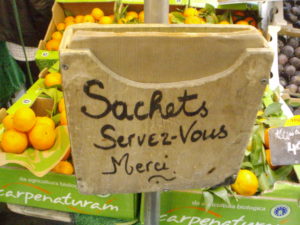
“Bags – please serve yourself. Merci.”
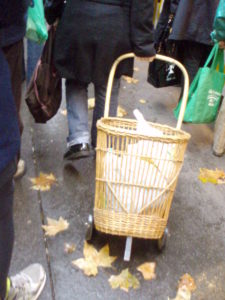
4) Bags and baskets: Vendors will put food items into disposable plastic bags for you to carry away, unless of course, you have your own market basket. Baskets distinguish locals from tourists…so pick up a basket from a basket vendor and blend in with the French. (Click here for a previous article on French market baskets.)
5) Prices: Market prices on food and the like are usually not negotiable. Sometimes vendors will throw something in for free, however, particularly as they wrap up for the day or occasionally you get a price break for buying multiples of something. Purchases are payable in cash so have some euros on you.
6) Tastings: The French love to offer tastes of their products. You can almost make a meal out of tastings at some markets. If you sample a product a vendor is offering, you are not obligated to buy. Say, “Merci beaucoup” and move on. But usually everything is so good that you’ll end up wanting to buy it anyway.
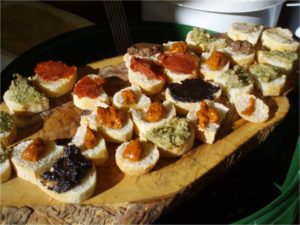
A tasting of tapenades and pistou rouge at a Provence market.
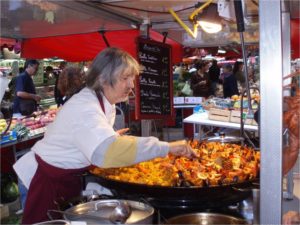
7) Ready-made foods: Some vendors sell prepared foods such as this paella vendor in Aix-en-Provence. If you want some paella for lunch, be sure and buy it early as he regularly sells out!
8) Don’t always buy from the first vendor you see: When visiting markets and vendors for the first time, I like to check out the entire market and then come back to the ones that have the best quality and/or price. If in doubt, note which vendors have the longest lines—the French always know good food and good bargains.
9) Lines: Speaking of lines, it is necessary to faire la queue (stand in line) to be served. When it’s your turn, you can make sure the vendor knows by saying “C’est à moi” (sayt ah mwa), or “It’s my turn.” When it comes to food markets, the French are pretty good about lining up in an orderly fashion. However, it can be a free for all in other venues such as the French post office, so beware!
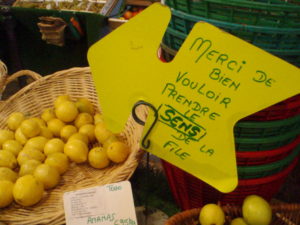
“Thank you for lining up in this direction…”
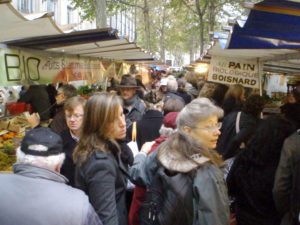
10) Crowds: Note that weekend markets are the most crowded. This means they are more festive but it can take longer to see what’s on offer and make your purchases.
11) Key phrases for use in the markets: It’s good to have a few French phrases handy to enable smooth market transactions and relations…and also to know how much to buy since the French use the metric system!
“Bonjour Madame / Monsieur!” (Always greet French vendors with a Bonjour and Ma’am or Sir. This goes a long way towards a good shopping experience.)
“Je voudrais un kilo de pommes, s’il vous plaît” (“I would like about 2 pounds of apples, please.” Since a kilo is about 2.2 pounds, you can ask for a pound of some by saying “un demi kilo,” a half kilo, or “400-500 grammes” which is about a pound.)
“Une tranche de pâté, s.v.p.” (A slice of your paté, please.)
“Encore un peu, s.v.p.” or “un peu moins, s.v.p.” (A little more, please, or a little less, please.)
“C’est combien?” (How much is it?)
“C’est parfait, merci.” (That’s great, thanks.)
“Merci beaucoup, Madame. Au revoir.” (Thank you, Madame. Good-bye. Be sure and close your shopping transaction with a nice thank-you and good-bye–it’s required French etiquette.)
After you’ve finished shopping, take a rest at a nearby café with the locals. You’ll overhear the latest gossip and can enjoy people-watching as the market winds up for the day. Have a coffee or do as many French do and celebrate market day with a glass of wine or pastis—even in the morning!
French Take-Out ~ La France à emporter
To find great markets wherever you are in France, consult guidebooks for the towns or cities you’ll be visiting. Markets are always noted there. In addition, you can browse the French tourist office websites “Office du tourisme” which will post market days.
For a visual tour of Paris or Provence markets, check out these books (they are a few years old but as interesting as ever with great market resources at the back):
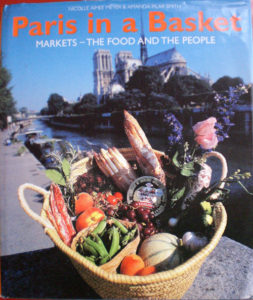
Paris in a Basket: Markets—The Food and the People by Nicole Meyer and Amanda Smith.
Markets of Provence: A Culinary Tour of Southern France by Dixon and Ruthann Long.