
I like old things. Places, villages, buildings, castles, antiques, all of it. I think it’s something about la patine du temps (the patina of old age) that makes the object in view more interesting and worth knowing more about.
I remember seeing the enormous Roman aqueduct, the Pont du Gard, in southern France for the first time in the spring of 1985. It was just sitting there in the middle of the dusty Provence countryside west of Avignon. You could approach the 2000-year old stone structure and walk on it and touch it as you wished. There was no tourist center or entrance at that time. My good friend Ann and I ventured out on to the top level of the Pont with the idea of walking all the way across, but the strong mistral wind bearing down the Rhône valley that day convinced us to change our minds. We didn’t want to be blown off the aqueduct into the river valley below. But it was pretty amazing to enjoy the ‘hands-on’ visit while it was still possible.
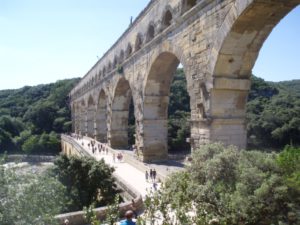
Today, the Pont du Gard is surrounded by beautiful visitor entrances on either side of the aqueduct and is as impressive as ever. The Pont was classified as a UNESCO world heritage site in December of 1985. In 2000, the modern visitor complex was completed to help manage the wear and tear of tourists on such a rare and valuable edifice. There is a superb museum and also a lovely restaurant in a former Provencal country house on the monument’s property. The Pont du Gard is now one of the most visited sites in France with more than a million visitors per year. Alas, these days only groups accompanied by official guides and security personnel are allowed on the top of the bridge itself.
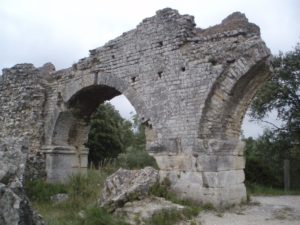
But not all historic sites are of the ‘don’t touch’ variety. The other day, my husband and I decided to check out the former Roman aqueduct of Barbegal on our way to Arles. Though listed in various guidebooks, it usually only gets a passing mention. A vrai dire (truth be told), it was like going to the Pont du Gard in 1985 again. We wound our way down a small country road bordered by olive groves and came upon the crumbling aqueduct almost by chance.* We parked behind one other car along the lane and set out on foot.
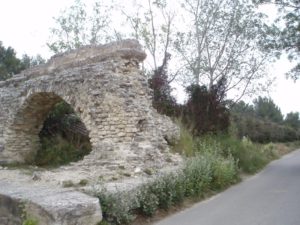
Within seconds, we were walking on and around the ancient structure. We were in the middle of France’s Roman Empire with no filter and nothing in our way. It was easy to imagine the aqueduct in its heyday and to get a sense of the work and design that went into building it.
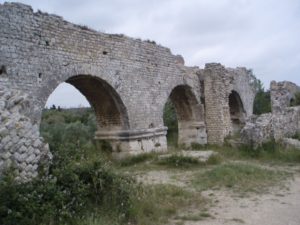
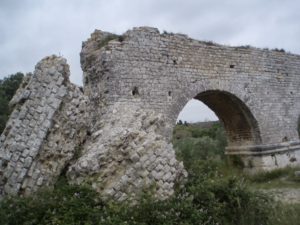
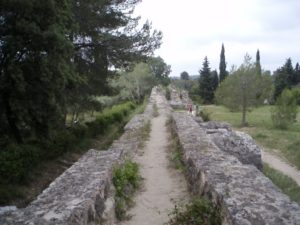
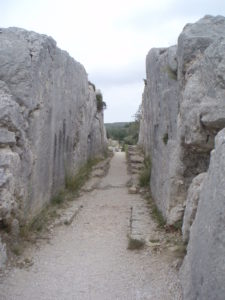
The sluice that used to carry water is still straight as an arrow. No mistral wind prevented me from walking across the top of the aqueduct on this day…
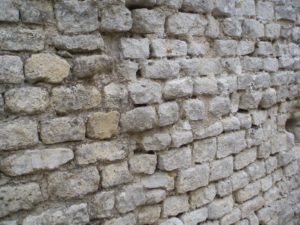
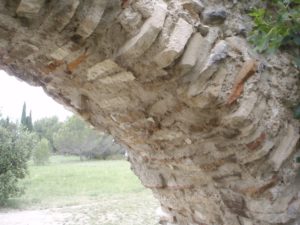
The human aspect of the construction was evident everywhere we looked. Fairly uniform stones were laid out in an orderly fashion like bricks. In addition, parts of the aqueduct were made out of flat stones and reinforced by baked red clay tiles. Clearly, a lot of individuals went to considerable effort to put this together.
Perhaps most étonnant (remarkable) was the part of the sluice that had been cut through the rocky hilltop at one end of the aqueduct. The water had been meant to flow out over the edge down into the fertile plain below.
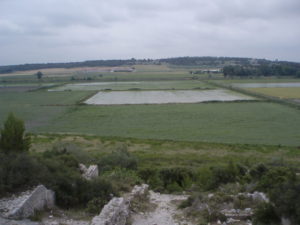
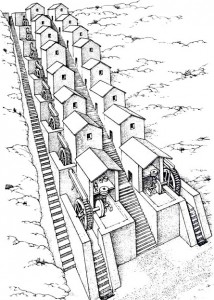
Intrigued, I later looked up some history on the aqueduc de Barbegal. Well, it turns out that this site was the most powerful hydraulic engineering system in the ancient world. Barbegal was constructed with two parallel aqueducts – one to carry potable water to the population of Arles (one of the most important Roman cities at the time) and the other to power a large flour mill capable of producing 4.5 tons of flour per day, enough to feed Arles’ population of 12,500 people. Historians believe that the water drove a complex system of 16 wheels and concentrated the power in the large mill’s machinery at the base of the hill.
It was hands-down the most fascinating historical experience I’ve had in a long time. For those who love history, I would offer this travel advice: Run, don’t walk, to visit this site before it gets polished up and gentrified. And by all means, take the kids. Hands-on history doesn’t get much better than this!
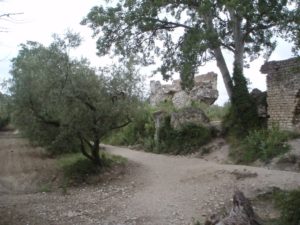
* The aqueduct at Barbegal is located near Fontvieille in Provence. Take the country road D33 south of Fontvieille and then follow the D82 slightly east until you reach the site.