
22. l’Éte en France
Over the course of our marriage, prior to moving to France, we visited almost every region. For ourselves, or because Elizabeth was organizing trips for French Affaires. The one region we visited more than others was les Alpilles. Where we first went after meeting for drinks in Dallas, then celebrating Palm Sunday in Maussane with olive branches for palms.
Living in France changes everything when it comes to travel. Want to go to Champagne for a day with the dog trainer, no problem. Loire Valley, just down the road. Beaune for date weekends, two-and-a-half hours in the car, on a fine autoroute (without any operation escargot) with an entrace ten minutes from our house. Paris for dinner. Why not? We had by this time found a super dog trainer in our area who could board Marcel. She became a close friend. Marcel has always been more happy when he has dogs to hang around with, and she could break up any male squabbles.
Now we could visit our favorites places in les Alpilles in a seven-hour drive. Sometimes the tunnel in Lyon could slow us down, but after that, it was clear sailing to Avignon and further south to the area around St-Remy-de-Provence where we liked to stay.
As well, Aix-en-Provence is but an hour or so away to the east. The Luberon above that, with its palette of villages perchés, each one delightfully different. Rousillon with its deep ochre colors. The slightly chic Gordes, next to the Abbey of Senanque, its lavender fields a riot of color from May to September. Menerbes, recovering from the invasion of Peter Mayle and fans of his books. The charming Bonnieux just below it. Ansouis, a small gem with a nice restaurant etoilé, looking south toward Puy-St-Reparade. Cucuron, Vaugines, Mirabeau, where Claude Berry set the scenes for the films of Marcel Pagnol.
Elizabeth had spent much time in Aix as a French student from Vanderbilt, a city sometimes referred to as Aix-en-Vacances, or Sex-en-Provence, because of its popularity and charm for foreign visitors. We would see it become more refined and tidied up over the years of our visiting. The language school there is the base for the popular “live like a local” offering, with daily immersion in the French language at the international school.
But we liked the Alpilles for plopping down for a couple of weeks. Reading, swimming, walking, eating well, the many morning marché in all the local villages. Maussanne, Fontvielle, Moriès, St-Remy, Tarascon, and of course Eygalières. We rented a small house at the top of the village one summer, and used it as a base of operations.
If you are ever in the area in early August, be sure not to miss the Fete de la St Laurent. We caught it one year entirely by accident. They line the main streets of this small village of 1800 inhabitants with big wooden barricades. We had parked our car, coming back from St-Remy, to head down to the market on the 10th of August and said, something is going on. Big horse and animal lorries had taken over the main parking lot to the west of town. Cowboys (in French les gardiens) were proudly strutting about.
It comes as a surprise to many that the Camarque region south of les Alpilles is home to French cowboys. This is a slightly exotic area, located within two main branches of the Rhone as it spills into the Mediterranean. Flamingos, pink sea salt, bulls, and gitanes (gypsies) who come for an annual homage to the Black Virgin. The bulls are bred for a specific kind of bullfighting. Not a Corrida, where the bulls are slowly worn down and then killed, but rather a rite-of-passage sport in an arena, where colored ribbons have been placed in the neck band of these enormous bruisers. The contestants are to leap up, grab a ribbon if they can, and then find a way not to get gored or killed. Vaulting out of the arena is the tried-and-true way. It is slightly carnival like to watch as an outsider, but serious business when you climb into the ring.
For this Festival, they let their prized bulls run the streets, chased or herded by les gardiens on horseback. The compact streets, short track for running—they go to the top of town near our summer rental and back down again—and thundering hooves on paving stones makes for a dramatic 45 minutes. They run the bulls back into the transport vehicles at the end of the course. Take a break. And do it again later in the day. Time for a pichet (pitcher) of rosé and a big salade niçoise. When fun things are happening, the French are not in a hurry. OK, a second pichet.
In addition to the many places to visit and enjoy, we also had a friend from Dallas who owned a nice modern home next to the towering Mont Ventoux. It is an hour north of les Alpilles and almost into the Department of the Drôme. She lived in Crillon-le-Brave. A widow, she had also bought two nice homes for her adult children and grandchildren.
Crillon, for reasons I don’t think anyone knows, unless it’s just a nice place, is full of former diplomats. We got the impression that one gets moved around a bit in this line of work, and after a while you get to know your fellow-diplomatic colleagues. Parties at Bonnie’s and at their homes always made for great conversation. Mostly British, they had been posted all over the world. Their stories were exotic, dangerous, but always full of adventure. Elizabeth became a very close friend to one charming woman who was undergoing cancer treatment. We all went to spend the day together in Avignon and then Carpentras to the south. We were so sad to learn she had not made it. Such lovely childen as well.
Two stories in particular. The market morning at the nearby Bedoin was a fixture and all the cohort of friends would never miss it. We’d sit at a favorite café and order coffee and people took turns going to get pastries at the boulangerie across the street. We just hung out there all morning, taking passes through the marché, buying some things—I got a nice Panama straw hat, Elizabeth some summer dresses—and returning for more conversation. We’d either pack up shortly before noon, or sometimes stay for lunch. When you have interesting people and great conversation, it is easy to be content with doing nothing.
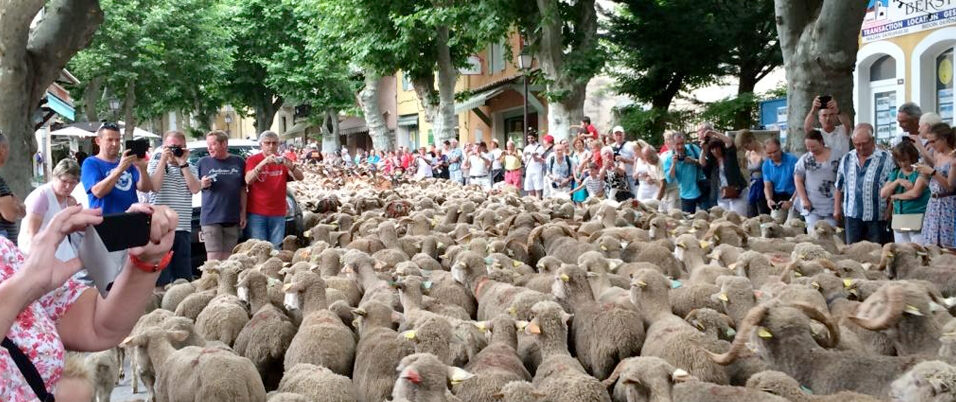
One year when we visited the annual transhumance was underway. This is the time when the sheep and goat herders move their flocks to new feeding grounds, as the seasons turn. This is the magic of France—be it horses and bulls running the streets, or the transhumance, or watching lavender wands (fuseaux) being made by hand without change or variant or machinery—the rhythms of the generations, unchanged and preserved, catching you up in their music. You are in the same streets as on the market day, now swarmed by animals as they pass by.
The other memory was of a concert to which we were invited by “Friends of Crillon-la-Brave.” Held in a tiny, ancient chapel, a short walk down a trail. I always worry about these local events. What are we in for, Elizabeth? Can we bail out if dull or amateurish? She looked at me with her usual look. We are going. Bonnie’s our friend.
The chapel held no more than 65. It was full. It was early evening. We were to be listening to a performance by an opera singer. It was he and an accompanist. The theme was an operatic piece concerning Petrach’s famous climbing of Mont Ventoux.
As one account summarizes:
The Italian poet Petrarch wrote about his ascent of Mont Ventoux (in Provence; elevation 1912 meters) on 26 April 1336 in a well-known letter published as one of his Epistolae familiares (IV,1). In this letter, written around 1350, Petrarch claimed to be the first person since antiquity to have climbed a mountain for the view. Although the historical accuracy of his account has been questioned by modern scholars, it is often cited in discussions of the new spirit of the Renaissance.
Our opera singer, standing not three feet in front of me, seated in the front row, gave a similar brief summary before starting. No one climbed a mountain for pleasure. Keepers of flocks and herds, yes, but that’s what they do for their livelihood. Seeing the vast world below from the top of the enormous dormant volcano, the poet Petrarch sensed the shortness and fragility of life.
Many say he invented the term “Middle Ages.” To know the “middle” of something you have to have a wider conception of history and time itself. The before. The to-come.
You have to have a perspective from above.
OK, this sounds promising. Off he starts. There is something about hearing a professionally trained opera singer in full voice in a chapel holding 65 people. The hair went up on the back of my neck. The words, in German, sought to capture Petrarch’s combination of astonishment and melancholy.
Elizabeth, thanks for insisting we go.
It is important to have a sense of where we are in our own lives. Your close friend from Crillon gone in her forties. The ascent to heights which produces awe, and which also reminds us of the grandeur that belongs to God alone, who gives us the span of life we have from his hand.