
18. La langue française and la vie a Courances
We are now moved in. Marcel is loving his new home and surroundings. Every morning, we rise, and after a coffee, he and I head to the chateau park. We have a big ancient key to the special entry door just down the lane. One of the perks of being a locataire is access to the grounds. Most of the renters live in Fleury so Marcel and I pretty much have it to ourselves. There is another couple who have horses who live inside the grounds, and we see them from time to time. The owners (the Marquise and her adult children) are rarely in residence, chiefly at holidays. They live in London, Geneva and other places due to taxes.
We get to know the various workmen and grounds crew.
I realize I need to up my French language game. Getting a haircut and making small talk is a real challenge. “Kids OK? How was the holiday? Did you try the new restaurant?” Elizabeth says, just stay silent. I am too extraverted. I’d love to ask Madame Coiffeuse what I sounded like when I first arrived and tried to find the words for “tapered, no line across the neck, can use clippers and scissors.” She commented in our fourth year one time, smiling as we had gotten to know each other by then. “Vous étiez nul.” You were zero.
I can laugh now, and the language for hair salon chatter is its own genre, but I wanted to move up from A1 (basic). We were now living in France. All the interchanges—pharmacy, wine shop, supermarket, physician, dentist, government this and that, post office, not to mention our new friends at church and in the neighborhood—were in French.
I thought to check with the town council in Milly-la-Foret, and sure enough, they had volunteers who were ready to help les etrangères tackle the language of their new home. I was given a name and address. Off I went excited at this opportunity—it was also free of charge—to work on conversational French. I had also been paying for weekly lessons in Fontainebleau, but I needed to ramp things up.
I knocked on the door of 5 rue de la republique and I was obviously in the wrong place. Pardon, Madame. Je me suis trompé. A very useful phrase when you are new in town. Back home, I phoned the volunteer (talking on the phone can be a special challenge). It was the rue de la republique in our own small village of Courances! How convenient. 5 minutes by foot.
And so would begin the start of a long and treasured friendship. My teacher lived next to the boulangerie on the main street of our three-street wide village. As with houses in the historical Courances, his faced the street exactly like our own. All you see as you walk down to the boulangerie are houses on either side of the street, whose actual property and disposition, behind the gate, you could only guess at. Or, if so inclined, use google earth.
In his case, answering the bell, he smiled and welcomed me into his property. He must have had a good two acres. You would never in the world know that or guess it staring at his wooden gate, not unlike our own. You enter a kind of world-unto-its-own. Big swimming pool. Play area for his grandkids. A second residence to attract their parents, his grown children. All enclosed by a high stone fence typical of the village, including our own home.
We would meet once a week. He was not a language teacher but had been a successful businessman (book printing) in Tours and Paris. He was retired to Courances. He would buy a small pied a terre in the 6th in Paris, at my urging. He and his wife were divorced and the social scene in Paris would be more conductive to female companionship than our otherwise very special area.
He had grown up in a big Catholic family, the son of the town physician whose office was on the ground floor of their big home in the Savoie. Since all we did was French conversation—his English was good enough to be able to step in when needed—this would become a very good way to get to know someone. Their childhood, work, family, hobbies, loves. And of course, mine as well.
He was an integral part of the village family. Also, Milly-la-Fôret and our other villages nearby. I should say a word about that.
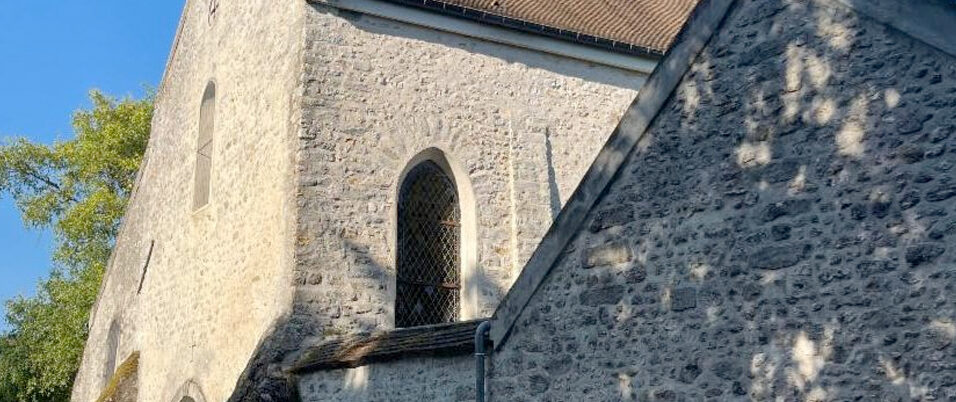
When the Angelus rang at our house, you could hear in the near distance two other Angelus bells pealing. Depending on how the wind was blowing it would the parish churches in Dannemois, Moigny-sur-Ecole, or maybe even Videlles. In the Catholic Diocese of Essonne, there were many rural parishes in small villages like ours and the ones I just named. Obviously, at one point in time when the great majority of villagers attended Mass, each village needed a central Parish church, and so it was. The church was a center of activity, usually next to the Marie or close by, and the most valuable bit of patrimony and history (patrimoine) proudly on display.
In the first years of the twentieth century, the law of laicization was passed in France, separating the church from the state, and probably more significantly, the church from the schools and the educational role it had exercised down the centuries. Much of this history was relayed to me by Gilles, as he had been raised Catholic and knew and respected the role I had as Anglican chaplain in Fontainebleau. He would comment on how very religious people in the US were; they put their hand on the Bible to swear an oath! I said that was pretty much a habit of culture without any sacred significance, and we didn’t have 40 feet high crucifixes greeting you as you entered the town.
The separation of church and state had the happy (probably unforeseen) advantage for the church that the buildings would come under the care of the communes where they were found, and where they represented the heart of the villages and of the patrimoine so valued by the French. I am sure there are some communist-leaning villages in the south of France that don’t let that get in the way of their strong anti-religious instincts, or even proper care for the buildings themselves. But anyone travelling through France knows how omnipresent village churches are, in a very good state of maintenance. A new roof? Of course. I want my funeral there. My daughter’s marriage (after getting legally married at the Marie), and so forth.
This isn’t Scotland where churches become pubs or private residences. Unheard of!
The parish church of Courances was part of the secteur pastoral consisting, in our case, of more than twenty parish churches and congregations. The distances were not great and that allowed for a big number being under the single care of the lead Curé. Hearing two or three ringing Angelus gives you the visual and auditory picture.
Of course, the combination of a clergy shortage and light attendance in our present day, would give way to this manner of proceeding. The three largest congregations would have Mass each Sunday at 11. As for the others, the clergy (three when we came, two when we left) operated on a rota. All the parish churches had lovely sanctuaries and had been well take care of. So, they would be used for an earlier 9.30 service, and then the pastor would jump in the car and race to the 11.00 every-Sunday one. Vested, behind the wheel, knowing the roads well, he made for an unusual sight – except that the clergy were well-known and this routine familiar.
Each parish church had a deacon who was the locum tenens (local cleric) and who made sure everything was all set when the priest arrived at 9.30 and 11.00. As a clergyman myself, from an Anglican background that likes to talk about lay involvement (the people of the parish playing a role), I was impressed with how efficiently things worked and especially how much responsibility for the parish life was in their hands. Music, catechism classes, school visits, even hospital chaplaincy. Sometimes a negative (fewer clergy) can become a positive. The laity are proud of their churches. Clergy, they come and go.
So, in the case of the parish church of Courances, next to our house, we would have Mass about once every seven Sundays at 9.30. Otherwise, we went to the 11.00, in our case at the church in Milly-la-Fôret. As well as all the other faithful (les fideles) in our village.
This is all prelude to saying that, in terms of general village life, our “family” extended to all those in the villages nearby who worshipped at Milly. Those who did not go to Mass (Gilles, for example) nevertheless belonged to this wider sense of family and friends.
I write this now so grateful that Elizabeth and me, and Marcel, were also part of this same family. Indeed, our priest friend, Père Paul Mercier, would often ask me, when we had 9.30 Mass in our church in Courances, if Marcel was in the garden. If he were to prop open the sacristy door, his Auvergne Highness would march right in and nuzzle everyone in the pews.
“I’d keep it shut.”
As charming as that might sound, take it from me, Marcel upstages every event where you imagine yourself in charge. Yes, he’s there, Père Paul Marie, better not prop the door open this day.