
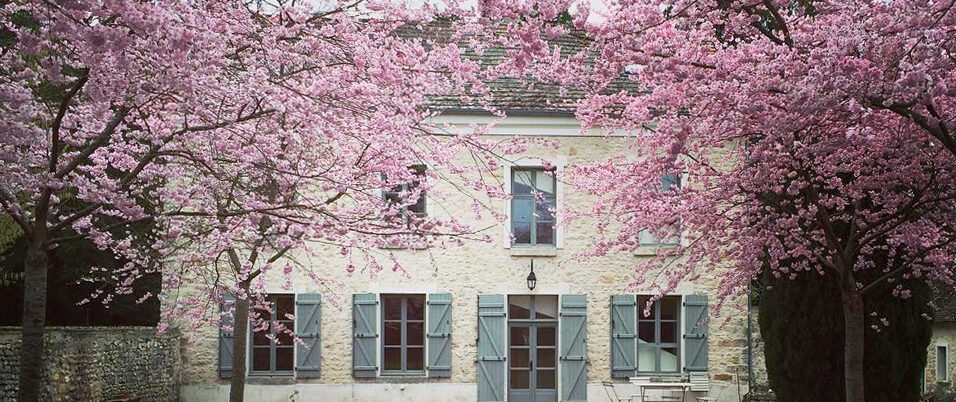
13. Our New Home at 7 rue du Petit Paris, le Presbytère
The work on our new house moved along steadily. No Peter Mayle anecdotes to share about sloppy or cigarette-smoking laborers, plumbers, joiners, roofers, tile men in the Luberon village of Menerbes. We had a superb Polish team of four and we just let them get at it. This is also the beauty of being a locataire (renter). The work is under the supervision of Patrick, on behalf of the Chateau of Courances. It is their property, and they want it done right.
We had one request. Knock out one wall space in the kitchen accommodating a small breakfast nook. We want the whole kitchen area. I agreed to plump for a gas oven/range that suited out cooking pleasures. The rest was up to them.
The Presbytere consisted of an entrance hall with toilet room under the stairs to the left, heading up to the first floor (US second floor). Beautiful, nicely word burgundy, hexagonal floor tiles ran throughout the house (tomettes in French). Ones chipped too badly were replaced. They even ran up the stairs with an accompanying wooden tread and black wrought iron railing.
To the right was the door into a large dining room, soon to be filled with antiques we would choose at a shop in Fontainebleau. A door led into the kitchen. From the window above the sink, you could see horses going by, clip-clopping along, rider’s waist at eye level. Rue du Petit Paris, the lane separating us and the chateau grounds with a tall stone wall.
The main ground floor room was the lounge with grand fireplace. Two triple glazed windows gave onto the stunning private garden area, that Elizabeth would restore. (In time, Victoria magazine would run a story on our house and her work). Upstairs were two large bedrooms and two full baths. The “red room” faced onto the courtyard below, my office (to be), and the massive ramparts of the church. I loved to nap on the bed when we were fully moved in, as I could glimpse the cross atop the church from my window there.
The main bedroom faced onto the garden, with bath to the rear. On the top floor, sous les toits, under the roof, was a third bedroom and a vast storage room, unfinished. I say sous les toits because that is what is said, and because it is literally so. Looking up, one sees the wooden supporting strips in tidy rows, upon which are fastened the ceramic roof tiles. Which are fully visible. A roof system proved to do the job going back to the origins of the house in the 17th century.
Two features of the house I absolutely loved. It was not square. The houses on the streets in Courances, and all over France in villages like ours, are flush to the street on which they are found. In our case, coming to the house on the street, one would have no idea whatsoever what lay behind the 9-foot-high wooden entry gate, flanked on right by the house itself and to the left by the outbuilding and garage door. The house and street are exactly aligned. You could peek into our kitchen window, but it is high up and small. The house faces down on you on the street, the upper level retaining full privacy.
This means that the disposition of the house itself, inside the gate, is set up with an eye to the garden allotment behind it, and the enclosed walls and, in our case, the parish church. One senses this only a little bit when inside the house. But in the second bedroom upstairs, for example, the interior walls do not come together at ninety-degrees, but, along the street and side at something like eighty-degrees. It gives you a sense of having been tucked into something larger and more determinative than the basic structure of the house itself.
And the second feature. The main bedroom we called the “blue room” and the second bedroom the “red room.” The walls of both were covered in toile suspendue. On the spectrum running from mediaeval wall tapestries to modern paint covering, the intermediate phases are toile suspendue and papier paint, corresponding to the age and technical skill of the period in question. Papier paint, wallpaper. Toile suspendue is a strong, colorful fabric attached only at the points contacting the ceiling, floor and wall. You can, if you wish, tug it and see it is not fastened but is suspended (suspendu).
This may also enhance the sense that the walls in red and blue rooms are not in fact square. Snug as a bug in a rug. Surrounded in the red room by period scenes, hunters, dogs, horses, and our friend M. Sanglier. In the blue, milkmaids, cows, streams, rolling fields. The cross on the church our neighbor keeping watch over us.
In the basement, entered by separate door, is the cave. A grand stone vaulted space, always cool, its wine storage racks soon to be filled with crates of red, white, rosé (especially when the local Carrefour supermarket holds its bi-annual 50% off sales).
I have mentioned the high water-table and abundance of water in the region. Beside my little office and lounge cottage, in the flagstone courtyard area, we had our own well. Not bucket hanging from a rope on a wheel, to be dropped into dark waters below. A source. With a staircase of some twenty steps, leading down to the freezing water below. Almost below the church itself.
The neighbors spoke of la Vierge appearing there to a sick woman hauling up water. In the land of St Blaise des Simples and St Etienne the healer, why not? The massive ramparts of the church rise above the staircase in protective cover.
We will be given a key to the sacristy on the back left corner of our property, next to the high rear stone wall. From there one can make one’s way into the cool, dark sanctuary, entering the world of a 12th century parish church and its worshippers, in Courances, our new home.