
8. Pierres d’Histoire
We knew that it would take a good six weeks to do all the work on the house. As it turned out, the Chateau was soon to be the home of a business venture associated with Pierres d’Histoire (“stones of history”). They are particularly active in the Isle de France area around Paris but have other projects in Normandy and across France. The idea is to take historical properties, restore them to a high quality, and then advertise them for holiday rental.
In the case of the Chateau of Courances, the concept is a little different. The Chateau in former times (it was built in 1630) had a good number of out-buildings associated with work taking place on the grounds. A mill. A cow milking barn. A workshop. A sawmill. A farm shop. These no longer active, the buildings had fallen into disrepair. They are all located within the grounds of the chateau and enclosed inside their gates. Pierres d’Histoire rightly saw their attractiveness as holiday cottages (gites in French) or small houses (as they like to call them).
There are also holidays lodgings run by them at the Chateau of Fleury-en-Biere, walking distance from the Chateau of Courances, and owned by the same de Ganay family. Only parts of that chateau presently inhabited, Pierres d’Histoire has chosen certain towers and other choice parts of the chateau to restore. Each setting has its unique features and offerings. In the case of Courances, guests have full access to the chateau grounds.
Elizabeth and I are frequent visitors to the Gardens of Eyrignac in the Perigord Noir (Southwest France) and know the charming owner. My wife is very pretty which gives her some unique advantages, paired with her intelligence and excellent French. I recall asking him what his favorite chateau and grounds was (apart from his own, of course). “Courances” he replied without hesitation.
There are no gardens at the Chateau of Courances as one thinks of that. Rather, there are water gardens, of the genre one finds at Marquessac and Eyrignac in the Dordogne, for example, or Versailles and (close to my German ancestor’s home) at Schloss Schwetzingen near Heidelberg. I am hardly an expert, though I have seen these water gardens regularly in travels across France.
What makes them unique, I believe, at Courances is their size, distribution, and the grandeur of the engineering feat. Not a single mechanized pump in involved, yet the water is constantly moving through a system of pools and long, grand canals. The largest at Courances was indeed a model for Versailles. There is a Japanese garden, a sort of folie, but apart from that—and it is charming, flanking the Pierre d’Histoire properties—Courances is known solely for the achievement of its water system and distribution of canals. It has remained a touch sauvage. Grand long alleys of trees. This would soon be our new dog’s playground, and ours as well.
Arriving in December at the Paris airport, in the morning hours, it is still dark. People tend to forget that Paris lies on the same latitude as the 48th parallel separating Canada from the United States. We went through customs, collected our luggage, found our way to the rental car area, and were given a nice sturdy station wagon. We knew our way to Courances, but this felt very, very special. We were beginning our new life in France. C’est parti!
At this time of the year, and early in the morning, and most importantly, not going into Paris, but rather to the Departments of Seine et Marne and Essonne, one can make reasonably good time. We are map people. The route can be tricky, and we thought to turn on the car’s GPS as an aide de route. Only problem. What popped up was Korean (as best we could make out), and without knowing the language, one could not operate the buttons that would get us into English or French. We’d have time to do something about that, before buying our own (second) French car.
I can remember to this day the joy of arriving. You come down the A6 and just before the pay station (péage) at Fleury-en-Biere, the exit reads Courances. If you know where to look, you can make out the long-running walls—crumbling here and there—of the Chateau of Fleury. This would become our “coming back home” route for the years to come. Busy autoroute giving way to stubble fields, and forests, track roads and walking trails that mark our arrival at the village of Courances.
You can see in the distance the church tower rising above the houses it surrounds, marking the place we will live for the next four years. The entrance road is marked with a high metal crucifix, with the Body of Jesus doing his saving work.
We come to the small town square. There is the Mairie. Christmas is days away. The area is adorned with carefully wrapped packages telling Pére Noel we are here and ready for his visit. A light snow has fallen. It is still morning, and the small village is quiet.
The Chateau dominates the village, once you get to the town square. The church, St Etienne, is now on our left. Our home is being prepared. We have been told where to park, for the lodgings of Pierres d’Histoire are just behind the gate next to our new home at 7 rue du Petit Paris. We feel we are being tucked into 17th century France, and that is because we are.
Patrick has stocked our new temporary home. Preserves, milk, coffee, tea, wine. A handwritten note with directions to the boulangerie. He knew our arrival time.
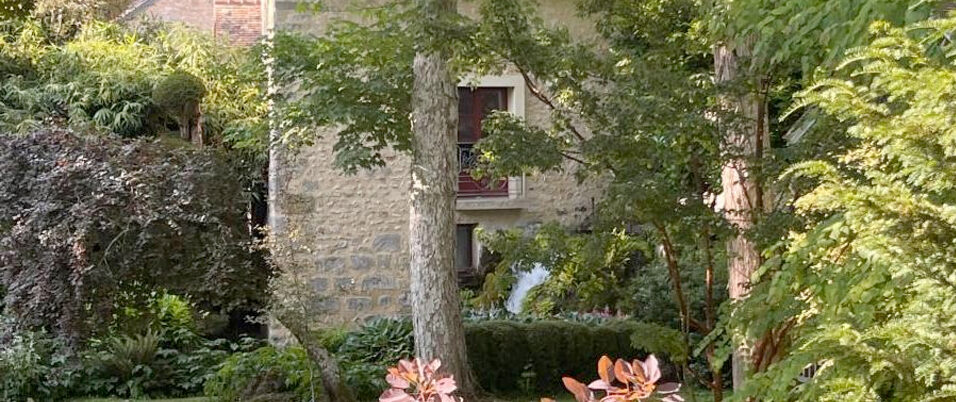
I unload the luggage. We find the key to le Moulin, the Mill (photo above, from a recent visit), and find we are alone among the 4 lodgings. We have the place to ourselves. It is dark, snow falling in light wind. I put on my Barbour coat and walk the 7 minutes to the bakery. I know Elizabeth’s favorite pastries. I add a warm baguette. I am excited to be in this special village, with my special wife, our Mill home, waterwheel slowly turning. Water coming to a boil for coffee.
I’ll build a fire when we have eaten and have looked around our new home, checked out the two bedrooms, small work areas, fire up the internet, and settle in.
How nice that last phrase sounds.