
4. La Halte du Temps
We had moved into our new house in the village of Courances. Our goods from the US had arrived. The house had been painted and a new kitchen put in. My office in one of the out-buildings, soon to follow. Elizabeth’s gardening passion re-commenced. The Angelus rang in our mornings. The boulangerie and market town now well known. It was time to get a puppy!
I have had hunting dogs and for me the main thing is getting first pick. There were five or six breeding kennels (elévage) in France for our new favorite breed, the Braque d’Auvergne. France being the size of Texas, I was not concerned about distance but instead the timing of mom’s birthing schedule. We located a kennel to the south of Toulouse, on the border of the Ariège and Haute-Garonne departments, whose nearest town with accommodations was the charming sounding, Montesquieu-Volvestre.
This is not a French Affaires trip location. The nearest known quantity for us was Cahors, not far from where we went on our honeymoon in the Lot/Perigord Noir region. The Dordogne region, as it is commonly known (“the river with 1000 castles”).
The best thing about French Affaires is you have every excuse to travel to places in France you have not been. “We’re doing research” covers every whim, every desire to learn about a new place on the map, every slight feeling of the need for an adventure. Elizabeth and I share a love of maps. We probably have 100 road maps and 50 ordinance maps for trail walking. Where is Toulouse? What is there? How long will it take and down which autoroute? What is the Ariège known for?
The bulk of the 7-hour journey is on the A-20. Vierzon, Chateauroux, Limoges, Brive le Gaillard, not your most enchanting trajectory. We had bought a VW Passat station wagon (diesel). It came with a super back area that would become the new travelling home of our dog-to-come, as we would ferry him all across France. “Him,” in that we agreed we wanted a male puppy.
Trip number one was to meet the breeder, and she us, and see the 4 week-old puppies (tired mom had nine!). We had spoken on the phone several times and been given the details of how she would operate upon arrival. We found an accommodation in Montesquieu-Volvestre on-line and were delighted that this would be the place she would also recommend. It was a “chambre d’hôte.” That is, the owner of the house had rooms to book, with meals to be taken there with the owners. La Halte du Temps looked charming at the internet site. A 17th century manor house in a bastide town.
A bastide is a fortified town laid out on a geometric grid, typically from the early Middle Ages. One is witnessing the rise of a genuine mercantile class, and defensive of its status as such. Travelers know that these bastide towns can be found in certain regions of France (I think of the famous bastide towns south of the Dorgogne, but equally elsewhere). Mercantilism can also be aligned with Protestantism of a later period (sixteenth century).
Well, we had never stayed at a chambre d’hôte, but it looked charming and there wasn’t a lot to choose from. We were headed to a remote region. Good. I rubbed my hands in glee. New breed, new region, rural and a bit rough, off the beaten track. There we would find our new companion.
Off we left early in the morning, excited by the adventure. What is not to like? France awaits and a French dog awaits. I drive. Elizabeth hands me the credit card for the péage stations, pockets the paper receipts and tells me when to stop á faire peepee (pit-stop).
I know the route quite well now, as I write this. It’s how you get down to the Dordogne, a popular place for French Affaires travel, where I would come down to join Elizabeth and keep her company. Eat and drink wine and enjoy the guests, all the hard work having be done by my sweet wife.
Hi, girl! I’m here. Let’s have a bit of our fun now.
A dull route but also one on which you can make good time. The French have a slightly vulgar expression that one associates with several of the places on the A-20. “Back of beyond” is a cleaned-up version of a phrase having to do with the anatomy of the backside.
Well, we are motoring along well. Making good time. Should be at our lodging in time to wind down and get an apero at our new destination. See the bastide town, stroll along the charming Arize river. See the historic church. The A-20 route is free of traffic and we are clocking the miles.
About 45 miles north of Toulouse is Montauban where the A-20 gives way to the A-62. It in turn forms a peripheral road around this sizeable town of about half-a-million citizens. Passing by Montauban, suddenly our lovely pace of travel came to a dead halt. I mean, dead halt. Slow enough for people to get out of their cars, every now and then, to gawk and scratch their heads or tighten their fists. The latter knew what was going on, yes, a strike. The omnipresent “manifestation,” “la grève,” as at the Paris Airport.
The French strike about anything and everything, as is commonly known. To the chagrin and puzzlement of outsiders. It’s a kind of national sport or pastime. We turned on the radio and yes, a strike was announced for the motorway around Toulouse. Isn’t that nice, they also actually tell you when they are going to ruin your trip, a trip, mind you, you have been paying for since the first pay station south of Paris. No matter.
Well, we had seen this kind of activity before, in general terms, on the highways. Truck drivers showing their support for the strike du jour somewhere else in the country, slowing down to annoy you for a couple of miles. But this was our first experience with the “operation escargot.” It means what’s on the tin. Truck drivers (poid lourd – 18 wheelers as we say), get athwart each other, straddling lanes, 4 abreast on three lanes so no one can pass, and go 5 miles per hour, or slower, depending on how much they’re enjoying it or due to orders from command central for today’s strike. I think it took us two hours to go about ten miles. My mind remains unclear from vestigial rage.
When you finally get to the place where they let you go by, there is a charming group of strikers smoking cigarettes, joking, burning tires if restless, waving you by as if they are in charge of nuclear codes or just generous enough to not hold you up another 5 hours, you may thank us. I was thinking how if you tried to pull this in the US, especially having handed over about $100 to travel on the road in the first place, your average polite Texan would pull out a gun, shoot the man waving you through with a cigarette in his mouth and a smile on his face.
We are not doing that anymore, thank you very much.
The phrase “La Halte du Temps,” the ever so charming name of our chambre d’hôte, means “A Halt in Time.” This damn Toulouse stoppage was not what we had in mind with that expression. After you have been moving along at under five miles an hour, you can’t help but hit the accelerator. And for all I know they turn off the speed cameras after having asked paying drivers to crawl behind truck drivers out to “operation escargot” your trip.
Fortunately, we did not have far to go. We were ready to arrive and have a glass of wine or something stronger.
5. An Evening to Remember
Having passed the strike gauntlet, an hour remained to the chambre d’hôte La Halte du Temps. We went straight there to book in and get settled. The 7-hour trip had become 10 hours and now it was about 6pm. A nice woman greeted us and gave me instructions about where to park the car. Our few bags were deposited, and I went off to park the VW wagon. Elizabeth speaks fluent French and is good at small talk – not easy until your language skill is good, and your ear for accents accustomed to that next higher gear.
I returned and was directed to the room. We asked for a bottle of wine, which she brought up, along with a tire-bouchon (corkscrew; bouchon also means traffic jam, so appropriate).
The manor house was large, and the rooms very nice. We would learn that Madame’s father had been a professor at the University of Toulouse, and this was the family home. The furnishings we assumed were typical of the Ariège and Haute-Garonne region (Garonne is the main river that traverses Toulouse, its capital).
We were bushed and a bit nackered by the annoying slow down. A glass of wine was putting that right. Madame had said dinner was at 8. She would see us downstairs. We would eat in the kitchen area, which had us assuming we might be the only guests.
We tidied up for a much-anticipated dinner, our stomachs growling. Making our way down the creaking staircase, we realized we had no idea where the kitchen actually was. I knocked and opened one door tentatively. It was her father’s study. Books on floor-to-ceiling book shelves. As an academic, I tried to guess his subject area but moved along on our search. No, not here. Then, at last a door that opened on what was obviously a kitchen. A table set for four.
A huge open cooking fireplace, such as one would use in the 17th century, dominated the cozy piece. A roaring fire brought us back into that century and manner of life. Now, where was Madame? We called out coucou. She was a warm-hearted woman in bearing, and not at all formal. In about an hour, we would be on tutoyer terms (the familiar “you”).
Je suis ici! Here I am, her kindly voice called out. Obviously, the former kitchen now a dining area, meant there was a modern kitchen. We passed through a half open door into a very nice preparation and kitchen area. She was, after all, running a business. The website showed us a well-stocked area for petit-dejeuner, when the season would be bringing guests to the region known for hiking, fishing, and all things rural. It was a region known as well for elévage: dogs, cats, bees, orchards, trout, you name it. When we would take the fifteen-minute drive to the breeding kennel, the windy roads and general landscape reminded me of West Virginia. “Wild, wonderful” as the ad campaign put it.
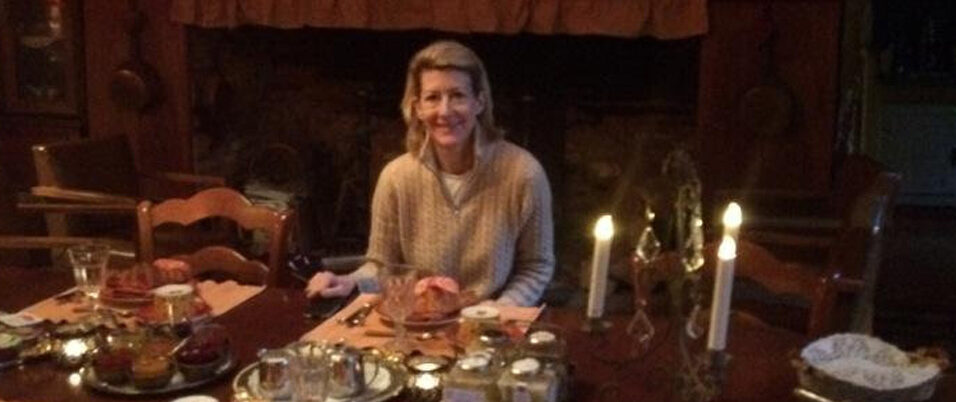
She assured us dinner was on the way. We chatted a bit, and she suggested we sit and stay warm (it was February) next to the fireplace. She handed me a bottle of red and a tire-bouchon. She’d be with us shortly. Volontiers (you bet) we replied. I was happy to return and sit in the cozy dining area. Elizabeth was wearing one her (and my) favorite outfits and her face was happy and glowing. This is why she and I moved to France.
We couldn’t help but notice that the grand table was set for four. Probably another guest we had not encountered (or whose room we had not stumbled into). This was our first chambre d’hôte experience and we were loving it. What a nice idea, especially if you own a big 17th century manor house in such a charming part of France, off the beaten trail.
In came the starter, Madame closing the door with her bottom, removing her tablier (apron), tray placed on the sideboard. I don’t recall what we ate that night, except that it was beyond exceptional. Perhaps a trout starter, I know it was a hearty beef or pork main dish, and I recall a superb accompanying sauce. The very special desserts sumptuously fruit filled, and not at all heavy.
But I am jumping the gun a bit. Elizabeth and I exchanged glances. She was across the table from me, and Madame to my left. The empty chair, with a setting like ours at the ready, was to my right. It was not our business to ask, and Madame seemed as if this was terribly normal. The first bottle of wine was doing its work. Madame clearly knew her routine, which meant she could relax, and we could talk.
I relive this experience now, able to speak flowing French myself, after being immersed in situations just like this, and a lot of mental elbow grease expended at language schools over our years in France. This is where it was a joy to be able to experience true French life to the full, because Elizabeth could easily pass as a native. Her French was impeccable.
We were learning about the region. About her professor father. About her family history. About the house itself. She knew Arlette, who was the professional breeder of Barque d’Auvergne dogs at the Ruisseau Montbrun kennel in Daumazon-sur-Arize. She sent her guests from all over France, all wanting this special breed. And in our case, a couple from Texas now living in Courances next to its historic Chateau.
Enjoying the conversation and moving at the usual French pace over our starter dish, pop, the door to my right opened and voila, the mystery guest had arrived. He did not look like a guest, but rather someone taking his customary place at the head, across from Madame. About her age. He said excuse me and tucked into the dish now placed before him.
Now this will be fun, I thought.
He was not averse to speaking and the conversation picked up, the fireplace and wine bringing much atmosphere and a lively feel of joy. He looked a bit rough, though obviously with high intellect. He was, as we would learn, a soixante-huitard. Literally, a sixty-eighter, what I suppose we would call a hippy, now about five years my senior. The year 1968 being the year of all the famous Paris student demonstrations. He smiled proudly in letting us in on his lineage and status.
Unlike Madame, he was from Paris. The Ariège was the place to come to live the free and real life. Back to nature. Live off the land. Woodstock. Break away from convention and formality. The University of Toulouse also had this same free spirit.
He had come down here to raise bees. The land and housing were cheap and easy to acquire on the properly rebellious soixante-huitard savings.
The main dish arrived. Madame offered her commentary at intervals. They were clearly a couple. We opened the next red. This was fun. Elizabeth glowed across from me, my back to the fireplace. He would rise and come back with a fresh load of wood from time to time. The meat dish—perhaps a local stew—was fortifying. Brilliant accompanying dishes passed by as needed. We were guests in the home and hearth of two true locals. He had not left this rural area from the moment of his arrival, now forty-plus years on.
The bee business was getting off the ground and he was “living off the land.” Then he got bit and was so ill the ambulance had to be called. Deathly allergic to bee stings. He put away his smoker and exotic suit, sold the business, and nursed his wounded ego. Plans crashing down.
Instead, however, he trained himself to be a fresco painter, got good at it, in time was contacted by Madame to do some refurbishing work for her, and the rest is history.
We talked about all kinds of things that evening. A third bottle went around. Dessert and the local marc (fruit or flower Brandy – reminded me of Bavarian schnapps). Fire restoked. Now past midnight. The operation escargot a blur in the rear-view mirror. We were indeed experiencing La Halte du Temps. A moment rich and rare. Clear in my mind even today. My happy and beautiful wife, reveling in her command of French and me keeping up not too badly.
I did ask what we were to make of the strike we just experienced, and Monsieur said, it’s just a grève sterile. A sort of gesture, meant to remind the public at large that sympathy for the worker is necessary. Did it make sense, was it productive? No, a sterile strike. Why didn’t people object? It’s a part of being French. We don’t do anything fast.
Like our evening, I thought to myself. A meal, good conversation, wine, a fireplace, a kindly couple happy to share their life with us.
This washes away the road grime and the fraught mind. We said thank you, merci infinement, and arm and arm climbed the staircase, Madame and Monsieur waving to us from the door of our evening together.
Une Halte du Temps. Indeed.