
3. Le Camino
“The Camino” refers, of course, to the famous pilgrimage trail, walked by countless pilgrims each year, to Santiago de Compostela, close to the Atlantic coast of Northern Spain. It is held to be the burial place of St. James the Apostle. Its distance away from normal paths of life probably helps lend to its exotic character, and popularity. Far-flung, challenging, a route able to be picked at various points along the way, but all the same: close or far from the final destination, one is a Pilgrim on the Camino.
In fact, there are manifold “camino.” One headed north from Portugal. One skirting across the bottom of France from Italy. Four major routes in France for pilgrims, from mediaeval times, spilling into this single country from all countries in Europe and Scandinavia. The best known one perhaps associated with Vézelay in Burgundy, the Basilica where Bernard of Clairvaux preached the second crusade.
And the paths of our own lives crisscross and double back and find their way to a common destination by many routes.
When I was a university student, I was fortunate to be asked to serve as a leader, along with two others, of groups going to Europe. Six weeks, 12 students, two VW camping buses. Crisscrossing Europe and meeting other groups and their leaders going counter-clockwise to ourselves. Along with all the obvious major capitals in England and Europe, we had challenging physical adventures. Climbed the highest mountain in Austria, kayaked on the Danube, bicycling in the Netherlands, hot air ballooning in the Loire Valley, and, running with the bulls at Pamplona. Yes, Hemingway was still holding students in his thrall.
I did trips two years in a row in summers in the late-seventies. The tales about those trips could fill a book. Crossing the Iron Curtain into (the then) Czechoslovakia to visit the stunning Prague. Stomping over an icy glacier to snowy trails to 3800 meters with boots and crampons and sturdy Austrian guides.
All of those pilgrimage trails headed to Santiago converge in the enchanting village of St Jean Pied du Port, in the Pyrenees.
Elizabeth and I were spending the first summer after our marriage in the Medoc, on the Atlantic coast of France. We were there for six weeks, in a gite (holiday lodging) outside the hamlet of Carcans. I was taking Sunday services for tourists and holiday-makers in the town of Soulac-sur-Mer, at the very top of this triangular region (Bordeaux on the east and the ocean on the west). The UNESCO heritage Basilica there has the ominous name, Notre Dame de la fin des Terres, Our Lady of the End of the Lands. It has a famous lighthouse and on a clear day one can make out Royan to the north. below La Rochelle in the Department of Charente-Maritime across the Gironde River.
All of this being due north of St Jean Pied du Port, here too in the Medic we have one of the four main pilgrimage routes in France headed south the Santiago.
So, three decades and half after my college “Camino” to the Pays Basque, to cross the Pyrenees at the famed Roncevaux (immortalized in the Chanson de Roland), and down to Pamplona for the running of the bulls – Elizabeth and I returned. In the car loaned to us for the summer, a lime-green Toyota station wagon, British drive (steering wheel on the right, left-hand shift). We carved our way through the vast Les Landes (formerly Gasgony), to the train station. I wanted to take the train again.
I had forgotten the lovely stews and omnipresent pimente d’espelette of Basque country. The charming train that chugs two slow hours up from Bayonne, below Biarritz. The bustling international charm, the excitement of pilgrims exchanging stories, the pelota courts, the unique admixture of Spain and France.
In 1978 we descended from the valley pass (Roncevaux/Roncevalles in Spanish) about 90 minutes by VW bus down to the plain surrounding Pamplona. Those 90 HP vehicles, loaded with 7 adults, luggage, even an electric guitar amplifier, gear strapped on the roof, have a top speed under the average Tour de France sprinter. We pitched our tents just outside of town alongside the Agra River. The fun had clearly already begun.
It was necessary to have those wanting to run, sign release forms. Girls running, should they so choose, was not yet fully acceptable to locals, but the times were “a changin,” as the music of the day put it. We would rise early the next morning and head to the top of the barricaded streets where the bulls were held in enormous pens.
I had a Spanish teacher colleague at the prep school where I was teaching after college who happened to have grown up in Roncevalles. She had all the necessary insider knowledge, as her brothers had run with the bulls regularly. You want to be at the beginning of the run, she advised, not the middle. Running at top speed the bulls are very fast, will stick close to the rump ahead of them, and will steam past you if you stick to the rail. Amazing how tall they are as they rush by like tauros locomotives.
But for now, the day was for joining in the festival atmosphere. This included buying a bota, a Hemingway made-famous wine bag that had once upon a time been a sheep’s bladder fitted with a nozzle. Now replaced with a manufactured version available at your local Pamplona bota shop. You head to the bar, elbow your way in, hand the bag to the barman, he fills it up with red wine, under a dollar for a liter. Behind the bar is the St Fermin speciality, stacked like mini cordwood, reaching to the ceiling. In wax paper oozing with olive oil, hundreds of sandwiches on rough baguette style bread, filled with a big fat egg omelet.
“I’ll take two.” 100 pesatas.
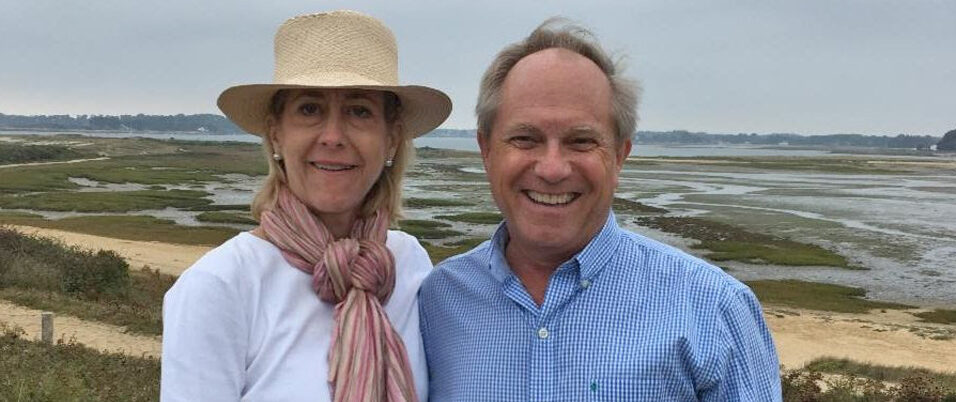
I think of this as we wander the streets of St Jean Pied du Port, 32 years later, Elizabeth and me, on our own reminiscing camino. Turning down a lane, we find a charming espadrille store. Actually, it is a small atelier where Madame makes the popular, timeless footwear. Pulling aside the curtain, she proudly shows us the work area. In the sales part of the store, stacked like those egg omelet sandwiches, each in their own niche according to size and style, was a wall of espadrilles, bursting with color and good taste. (Now outfitted with soles other than rope). “Elizabeth, they are so inexpensive, go ahead and get a bunch of them.”
We stayed in a charming cottage on the main street. Ate well. Did some hill climbing. Enjoyed the altitude. Memories of early days of my life, just as Elizabeth recalled hers in the small village south of Fontainebleau. The pilgrimage trails of our life. Converging at St Jean Pied du Port.
France has forty different countries inside her borders, the Pays Basque being one of them. We will return to the Medoc in chapters to follow.