
It’s fall in France and the U.S. and for me, it’s a return to winter cooking. I love gratins—vegetables such as potatoes layered with cheese and cream or milk—and hearty plats (main dishes) cooked with wine, mushrooms and onions. Sweaters and fires in the fireplace complete the picture.
A quintessential French winter dish of course is boeuf bourguignon (literally, Burgundy beef) which has enjoyed quite a renaissance lately due to the book-made-into-a-movie Julie & Julia. Julia Child’s recipe for this noteworthy stew made with Burgundy red wine is my favorite (pages 315 to 317 of Child’s Mastering the Art of French Cooking, Vol 1 or click here to see it online) and brings the region of Burgundy right into the kitchen.
But Burgundy is much more than its justly celebrated cuisine and wine: art, history, politics, culture, castles, nature, and more make this area of France worth exploring over and over again. Fortunately for several cities in the U.S., Burgundy is coming to us for the next two years—through its art. The spectacular exhibition “The Mourners: Medieval Tomb Sculptures from the Court of Burgundy” kicked off its American journey at the Metropolitan Museum of Art this past spring, made a stop in St. Louis and is now at the Dallas Museum of Art.
In the late 1300’s and 1400’s, the Dukes of Burgundy were powerful nobles and significant patrons of the arts. Two of the dukes, Philippe le hardi (Philip the Bold) and his son Jean sans peur (John the Fearless), were commemorated after their deaths by spectacular tombs housed today in Dijon’s Musée des Beaux-Arts.
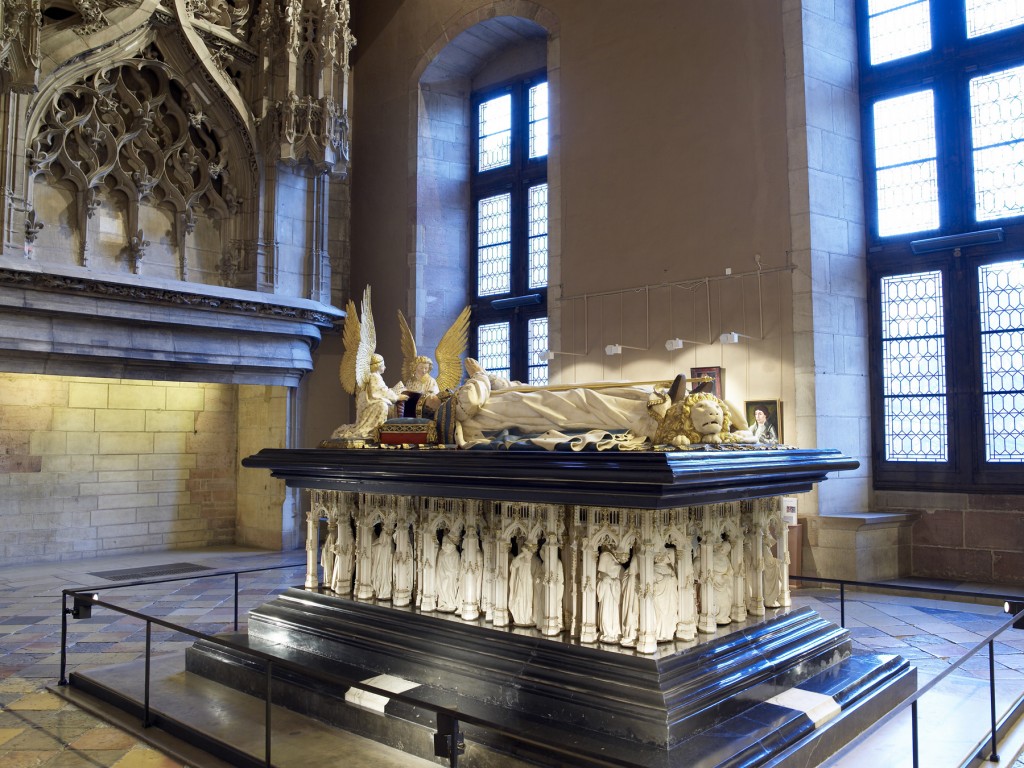
While the Dijon museum is undergoing extensive renovations over the next few years, it is sharing the exquisite alabaster sculptures of mourning figures from the lower portion of John the Fearless’s tomb.

These pleurants, or Mourners—from the French verb pleurer meaning ‘to cry’ or ‘to weep’ in English—are about 16 inches tall and pack a powerful emotional punch. There are nearly 40 of the sculptures representing a funeral procession at the Duke’s death. As Sophie Jugie, the Director of the Dijon museum and exhibition curator, notes in the catalogue:
“The mourners from the tombs of the Dukes of Burgundy are deeply affecting works of art. Beyond their evident visual & narrative qualities, we cannot help but be struck by the emotion they convey as they follow the funeral procession, weeping, praying, singing, lost in thought, giving vent to their grief, or consoling their neighbor. Mourning, they remind us, is a collective experience, common to all people and all moments of history.”
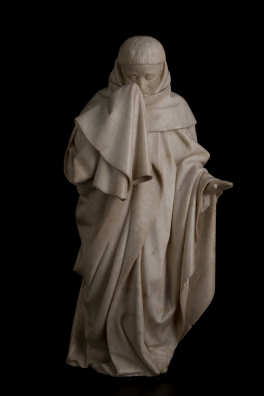
But the Mourners exhibition is far from sad or depressing. The figures are breathtaking as oeuvres d’art (works of art). They are sculptures that appear both medieval and freshly modern at the same time. And they are a witness to the artistic vision of the various sculptors who worked on them six centuries ago.
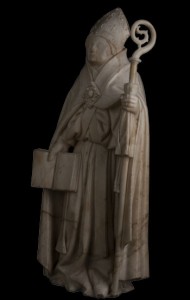
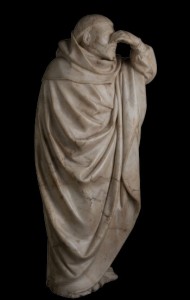
I have seen the Mourners several times—both in their native habitat in Dijon and at the Dallas Museum. The benefit of their American visit is that the figures can be appreciated to their fullest extent—i.e. we can view them on every side. In Dijon, the tombs provide a luxuriously beautiful context but the Mourners can only be viewed at a partial angle as their backs or sides are adjacent to the tomb.
Besides appreciating the figures ‘in the round’, other suggestions for getting the most out of this art exhibition are: 1) When viewing the hooded mourners whose faces aren’t immediately visible, be sure to bend down and look up into their hoods–their entire faces are there in wonderful human detail, 2) Go to the museum at a quiet time for a more contemplative viewing of the sculptures. Noisy, crowded galleries detract quite a bit from these artworks. 3) Take the viewing experience one step further and walk through it with medieval religious music playing on your IPod headphones. I can’t wait to do this last one!
Here is the Mourners exhibition schedule in the U.S.:
Dallas Museum of Art: Through January 2, 2011
Minneapolis Institute of Arts: January 23, 2011- April 17, 2011
Los Angeles County Museum of Art: May 8, 2011 – July 31, 2011
Fine Arts Museums of San Francisco, Legion of Honor: August 21, 2011 – January 1, 2012
Virginia Museum of Fine Arts, Richmond: January 20, 2012 – April 15, 2012
(Before they return to the capital of Burgundy, however, the Mourners will make a final stop at the Cluny Museum, also known as the Musée national du moyen âge / National Museum of the Middle Ages, in Paris in 2012.)
The ideal would be to see them both in the U.S. and later when they go home to Dijon. Il faut rêver, n’est-ce pas? (We have to dream, don’t we?) At the very least, we are fortunate that Burgundy and a special part of its art will be in the States for about two years. Be sure and mark your calendar to see the Mourners exhibition closest to you—it is a gift of France not to be missed.
French Take-Out™ ~ La France à emporter
If you have not been to Burgundy, one of its signature images is its colorful roof tiles. The center of Dijon has several examples covering the roofs of houses and mansions built by the wealthy from the Renaissance until the French Revolution.
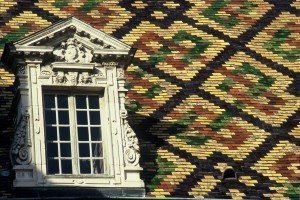
In nearby Beaune, you have one of the more flamboyant examples of roof tiles on the Hôtel-Dieu, the city’s former hospital. This fifteenth century building of Burgundian and Flemish architecture is a showstopper in every sense. In anticipation of seeing the real thing next time you are in France, you can pick up a charming carte maquette (paper model) version at The Whimsey Shoppe French antique store (Henderson location) in Dallas.
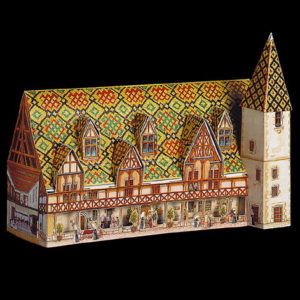
They also have several other paper models of beautiful French landmarks including the Cathedral of Notre Dame in Paris. To visit The Whimsey Shoppe online, click here.